
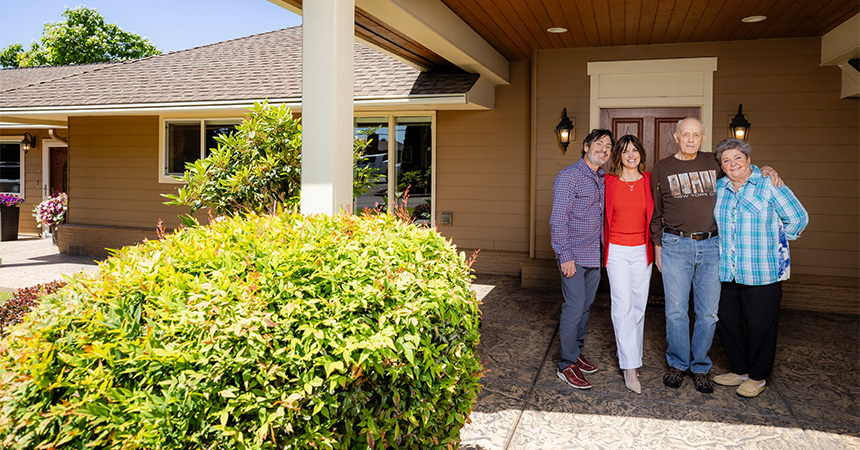
When Garry and Heather Egan set out to buy a home, their budget kept falling short. A preapproved loan meant compromise at every turn with small lots, dated finishes and other trade-offs that felt like half a home. Something always had to give.
The answer came from family. Heather’s parents, Ken and Patti Dobrowolski, were also weighing a move. Garry’s idea was simple: join forces. “We’re already really close with my parents,” Heather said. “We make dinner, we share resources. This just made sense.”
What they needed was a property that could offer two households genuine independence without sacrificing connection – single-level living for Ken and Patti, and room to breathe. Sixty days into their search, they found it.
A house with history
The property in Dallas, Oregon, was not a typical listing. Built as a farmhouse in 1956, it was extensively renovated in 2016 into a 3,200-square-foot, five-bedroom, four-bath home designed to serve as an adult care facility for five people with disabilities. For 30 years the Farrelly Foster Home was run by Gayle “Theresa” Farrelly.
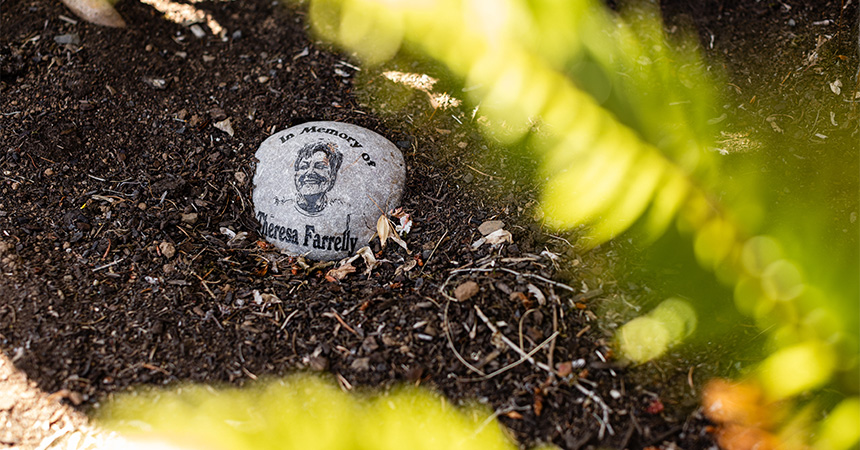
The property showed the care Theresa took in its wide hallways, wheelchair accessible and communal gathering spaces, fireplaces and a well-tended lush garden. Theresa died in May 2025, six months after transferring the home to a trust. A carved memorial stone for her rests in the garden, and the landscaper who came after remembers her fondly.
The Egans knew they acquired a meaningful home. They reached out to Theresa’s family to say that it was in good hands, and they affectionately call it by its street number. “There was a lot of history and love in this place before we got here,” Heather said. “We’re just continuing that.”
What the attic told them
The house had good bones and recently updated windows. But when Garry, a detail-oriented software developer who works from home, went through the home inspector’s report, one issue stood out. The roof was nearing the end of its life, and the attic beneath it told the rest of the story.
“The insulation was original – meaning barely any,” Heather said. “When we went up and looked, it was basically nothing and looked like crumbled old newspaper.” It amounted to 6 inches of degraded cellulose insulation that wouldn’t help the house keep warm in winter or cool in summer.
Garry took the project as his personal responsibility, calling Valley Insulation in Salem to evaluate the attic. They confirmed what the inspection had flagged and informed the family of an incentive through Energy Trust of Oregon, since Valley Insulation is a trade ally contractor.
Changing the math
For a 3,200-square-foot home, the Energy Trust incentive came out to about $3,200 — significant for a family that stretched its finances to close. Like many homeowners, the Egans had little left over after financing fees, down payment and moving costs.
Garry rolled the incentive straight into the project. “Without the incentive, we would have gotten the minimum R-Value, maybe R-13 or R-14,” he said. “With it, we took it to R-30.” That’s more than double the planned insulation value. The difference is now more than 3 feet of modern insulation filling the attic.
First, Valley Insulation removed old material. Garry then hired a general contractor to pull up boards and do deeper prep work, such as clearing bulky debris and air sealing the attic against leakage. Valley Insulation then returned to install the new insulation.
Valley Insulation also handled the Energy Trust paperwork. They sent the Egans a document to sign, submitted it on their behalf and provided a confirmation number. “It was my first rodeo, so having that confirmation number back was great,” Garry said. He appreciated that they quoted them their best price up front. “They gave us their best deal, with some decent cash coming back, too.”
What they notice now
The Egans moved in during a record cold snap before the insulation went in. The difference was immediate and obvious after the project completed.
Now when it’s warm, they blast the air conditioning for a few hours at night, turn it off, and the house stays cool well into the next afternoon. Or they can leave the furnace off for days and see only a 1- or 2-degree change inside. Their energy bills in the new 3,200-square-foot home are lower than when they rented a two-story townhouse.
The family is grateful for the incentive. Ken Dobrowolski, who lives in the connected wing with Patti, put it plainly: “Now it stays warm if you want it warm and chilly if you want it chilly.”
Garry — who has the house running on full home automation with voice-controlled blinds, garage and lighting — is still the one who meddles most with the thermostat. Yet he knows the role insulation plays in maintaining comfort. “It holds its temperature so nicely,” he said. “I can zap it with some cold, turn it off, and it stays that way for three or four hours.”
“We would have had higher bills,” Garry said. Instead, the family home is exactly what they envisioned. It is a place where two families can share a life without giving up lives of their own.