

Amy’s Kitchen teamed up with Energy Trust to boost efficiency and reduce waste at its Medford facility
For Amy’s Kitchen, commitment to sustainability runs as deep as its commitment to wholesome, organic food. As one of the largest independent organic vegetarian food producers in the United States, the company has built its reputation by cooking real food with care, using ingredients you’d likely find in your own kitchen.
Family-owned since its founding nearly 40 years ago, Amy’s continues to cook everything in-house, operating its own facilities – including the one in White City, Oregon, near Medford, where frozen pizzas, burritos, entrées and soups are made by a team of about 700 employees.
The hands-on approach to food production naturally extends to how the company manages energy, with a focus on operational efficiency and continuous improvement across its facilities.
When operating large, energy-intensive food plants, every incremental improvement counts. And in Medford, where the company has been part of the Rogue Valley community since 2007, that philosophy of continuous improvement recently led to a practical, high-impact energy upgrade.
A continuous improvement mindset
Energy use in food manufacturing is complex. Cooking, refrigeration and process loads dominate, and upgrades can be hard to prioritize when production schedules are tight and margins are thin. “In food manufacturing, capital tends to go first toward what directly increases or improves the ability to make food,” Renaud des Rosiers, Amy’s director of sustainability said. “Energy infrastructure projects can be hard to prioritize when weighed against a new sauce kettle or dough mixer that are rightly seen as mission critical.”
To keep efficiency moving forward, Amy’s built long-term partnerships that help identify and implement the right projects at the right time. Over the past few years, the Amy’s team began working closely with Energy Trust. Amy’s received no-cost technical support and detailed audits that revealed opportunities to trim waste and improve operations—without overwhelming their on-site engineering staff.
“Energy Trust really helps us prioritize,” said its Engineering Manager Jason Rowe who emphasized that “they bring in energy efficiency experts to support our in-house engineering and operating teams.” This outside perspective can help prioritize opportunities by identifying inefficient energy use that often goes unseen during day-to-day operations, while also quantifying these savings and building the case for action.
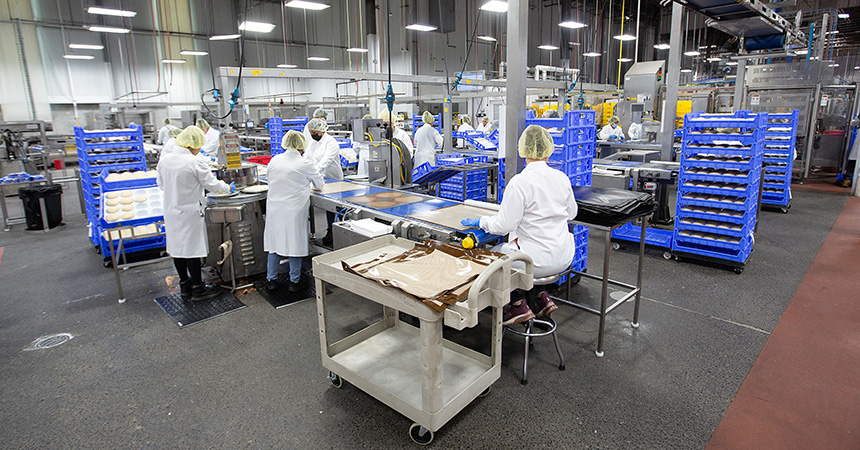
Amy’s received $20,000 in cash incentives from Energy Trust which covered a significant portion of project costs
Identifying a simple, high-return fix
One of the first opportunities that stood out was also one of the simplest: failed steam traps. Amy’s roughly 400,000-square-foot Medford facility uses a central steam plant to generate heat for cooking processes. Steam circulates through stainless-steel kettles and other equipment to cook sauces, soups and fillings, before being collected for reheating and reuse.
Steam traps act like pressure valves, ensuring steam flows properly and condensate is removed safely. But when a trap fails in the open position, valuable high-pressure steam escapes directly into the atmosphere. The result is wasted natural gas used to generate that steam—and lost dollars.
Energy Trust’s walkthrough identified 40 failed steam traps in the Medford plant. Replacing them was a straightforward job for the maintenance team, and the savings are substantial. As a natural gas customer of Avista, the project is now estimated to save more than 70,000 therms of natural gas per year, or almost $37,000 in annual utility savings.
“These are mechanical parts, not high-tech systems,” des Rosiers said. “But fixing them was like turning off a set of open valves pouring energy into the air. For a relatively small investment, the impact was huge.”
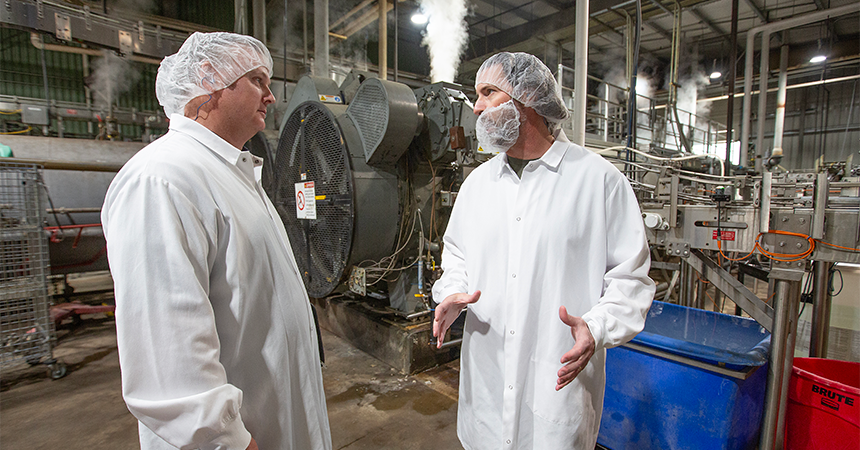
An Energy Trust representative Scott Scheuneman (left) and Engineering Manager Jason Rowe (right) discuss how replacing failed steam traps can increase efficiency and bring down utility costs
Partnership that makes projects possible
Through Energy Trust, Amy’s received $20,000 in cash incentives, covering a significant portion of the overall project cost. Beyond the financial boost, Amy’s team valued the technical expertise and facilitation that helped turn a simple idea into a completed project, along with a straightforward form that made it easy to move the project forward.
“In a production environment, everyone’s first job is keeping the line running,” Rowe explained. “When Energy Trust can come in with a thermal camera, locate exactly where the problems are, and even mark them on a blueprint, that changes the equation. Suddenly, a lower-priority maintenance issue becomes an actionable project with quantifiable benefits.”
Energy Trust’s involvement didn’t stop with steam traps. The partnership has generated a prioritized list of efficiency opportunities for future years—from optimizing exhaust-fan controls to deeper process improvements. Each project is being evaluated for feasibility, payback and potential Energy Trust incentives to help make it pencil out.
Looking ahead
The Medford facility’s steam trap replacement reflects exactly the kind of grounded, measurable progress the company values. “We’re proud of doing things the right way,” des Rosiers said. “This project shows that small, practical steps can make a real difference—and when you multiply that across our portfolio, the impact adds up.”
For Energy Trust, the collaboration with Amy’s highlights the power of partnership in helping manufacturers of all sizes stay competitive while reducing energy costs.
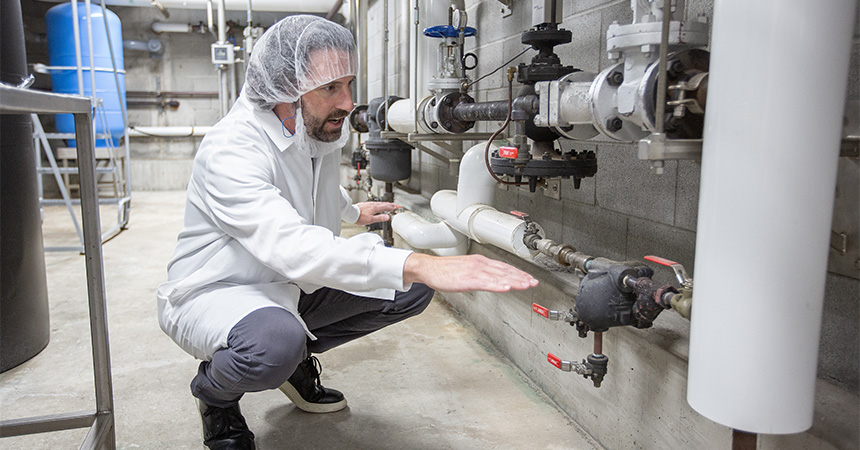
Engineering Manager Jason Rowe points out the impact that this simple change made in their facility
Key project results
- Received $20,000 in Energy Trust incentives, covering nearly 90 percent of total project costs
-
Yielded $37,000 in annual utility savings
- Achieved an estimated annual natural gas savings of more than 70,000 therms
- Reduced operating costs and avoided wasted energy from failed steam traps
- Improved process reliability and reduced maintenance demands
Learn more about Energy Trust’s cash incentives for steam traps.
You can also reach our team directly to answer any questions you have. Give us a call at 1.866.202.0576 or email at production@energytrust.org.