

Laura Scholtka spent her career as an insurance claims adjuster before retiring early in 2012. These days, Laura enjoys life in Two Rivers Co-op, a tight-knit 55-and-older manufactured home community in Gladstone where she has lived since 2021.
By her own account, she has had a great life. What she didn’t have was a working air conditioner. The central air unit on her 1976 manufactured home was as old as the home itself, and inoperable.
The cost of falling in between
Scholtka, 71, lives on a fixed retirement income. It’s comfortable, by her account, but it doesn’t leave room for $15,000 in necessary and prudent home repairs. She also learned by experience that her income consistently landed just above the cutoff for county and other assistance programs. “I don’t qualify for county funding, anything like that,” she said. “I don’t apply for many programs because I know I don’t qualify, and I wouldn’t want to take it away from someone who needs it more.”
That’s what made Energy Trust of Oregon’s In-Home Energy Services (IES) program different. IES is an income-qualified program that is designed to help overcome barriers that have historically prevented people like Scholtka from completing home retrofit projects that lower bills, and increase comfort and efficiency.
When Mount Hood Ductless, an IES participating trade ally contractor, presented the IES program at a Two Rivers Co-op community meeting, Scholtka was excited. The qualifying income thresholds were higher than what she had encountered elsewhere, wide enough to include retirees and working people who don’t fit neatly into low-income brackets but still feel the weight of a major home repair. “The qualification amounts were much higher, so I did qualify,” she said.
She filled out an online questionnaire the same day she heard about the offer, among the first residents in her community to do so. Within two weeks, Energy Trust sent an IES Energy Advisor to her home for a no-cost assessment.
What the assessment found
A Building Performance Institute-certified assessor with Tom’s Home Services visited Scholtka’s home, documenting dozens of details. A furnace and air conditioner both nearing 50 years old, and severely damaged belly wrap and floor insulation, much of which had been torn apart by animals from the nearby Clackamas River. Belly wrap is the fabric or plastic sheet stretched under a manufactured home that holds the floor insulation in place and keeps out moisture, pests, and outside air. The assessor also found a master bathroom with no exhaust fan, a significant moisture and indoor air quality concern.
Two contractors handled the repairs. Mount Hood Ductless installed a new ducted heat pump to replace the air conditioner and furnace. They also completed several critical repairs, including adding a new bathroom exhaust fan, and critical gutter and downspout repair. JARA Environmental Services repaired the home’s underbelly and replaced the floor insulation.
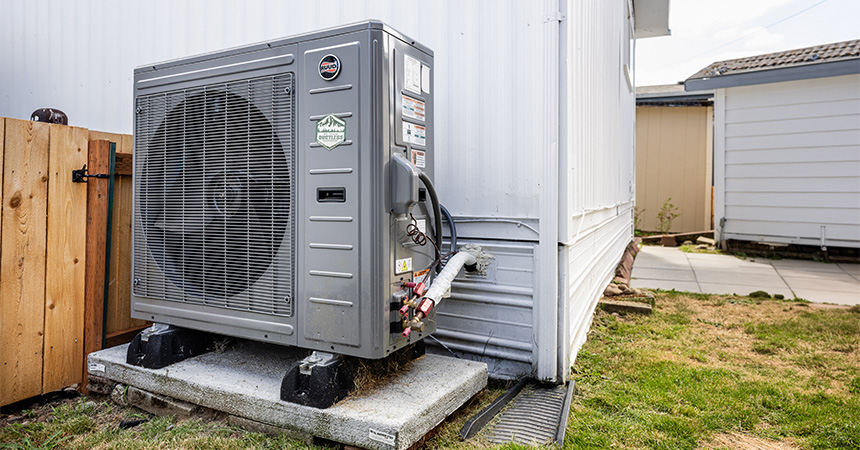
Critical repairs like the bathroom fan and gutter work are reserved for projects that address health, safety or structural issues alongside efficiency upgrades. Additional funding for the insulation work came through the Climate Equity and Resilience Through Action grant, a federal grant administered by the Oregon Department of Environmental Quality. Combined, Energy Trust incentives covering the project totaled $15,175.
One recommendation could not be completed. The assessment suggested replacing Scholtka’s electric resistance water heater with a heat pump water heater, but the water heater closet in her manufactured home was not large enough to accommodate one.
Comfort she can finally afford
Scholtka rated both contractors a 10 out of 10 in a post-install survey, calling the heat pump’s effect immediate. In past winters, with her old electric furnace working overtime, her bills ran $180 to $200 a month, and she still kept the thermostat down around 62 degrees to manage costs. This past winter, running the new heat pump at 70 to 72 degrees, her highest bill was $75 to $80.
Summer told a similar story. Before the upgrade, with no working central air, she relied on two standalone room air conditioning units and still saw bills as high as $200 a month, even running them very sparingly. With the new heat pump, her highest summer bill has been around $60.
The heat pump also reduces humidity, something Scholtka did not expect. She now keeps her home around 76 to 78 degrees in summer and says it feels noticeably cooler than that. “I have a friend who’s always warm,” she said. “When I kept the house at 78, he said it’s like walking into a grocery store.”
Word about the program spread through the close-knit community. Scholtka estimates about 20 of her neighbors have completed similar projects, with more signing up.
For Scholtka, the upgrades meant no longer sacrificing comfort to manage a bill. “I’m not afraid to use the heat pump when I need it,” she said. Left to fund the work herself, she said she likely would have repaired only the floor and belly wrap and lived with her home the way it was for years to come. Instead, her 1976 home now runs efficiently year-round, an example of what’s possible for homeowners who fall in the gap between qualifying for assistance and being able to absorb a major repair on their own.