
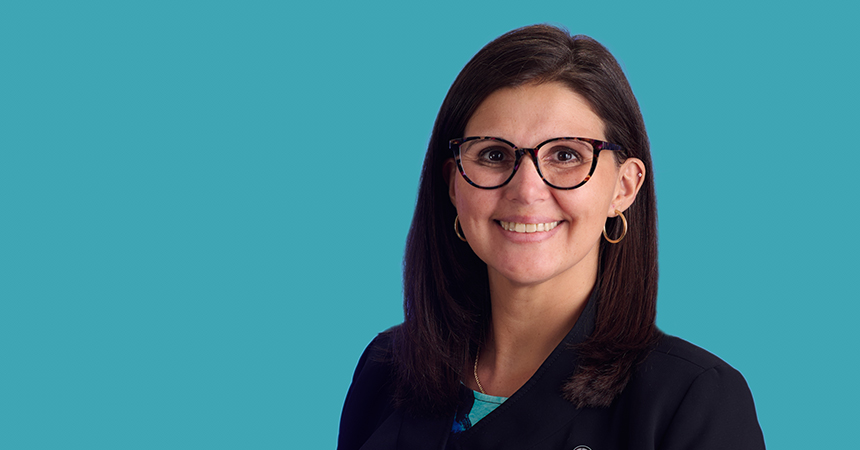
This is a part of a series of blog posts amplifying community voices. These views reflect the perspective of the Changemaker and do not necessarily represent those of Energy Trust.
Jackie Santa Lucia’s 15 years in architecture and design span educational institutions, museums and commercial and residential developments, including her previous roles as an Associate at Hacker Architects in Portland and as a project architect at Ewing Cole’s cultural studio in Philadelphia and New York. Since 2022, she has been a senior development manager at Adre, a socially responsible real estate development company focused on creating social and economic benefits for communities of color through its projects. Beyond her professional practice, Jackie has dedicated over a decade to design education as a tool for social justice, co-founding and directing Your Street Your Voice (YSYV), a program that provides paid learning opportunities in design and construction to Oregon youth.
Was there a moment or experience that made you think “architecture is what I want to do?” Or were there places or communities from your early life that influenced your focus on social and environmental justice in architecture?
I grew up in rural New Jersey, surrounded by woods, yet situated between New York City and Philadelphia. My family worked in New York, so I spent a lot of time traveling between the city and the countryside. Early on, I noticed how dramatically environments shape people’s lives. Visiting friends and family in Newark, I didn’t understand why the city felt so vacant, a place to move through rather than to live in, while homes were full of joy and life. Now I understand that cities like Newark bear visible scars of decades of racial violence, police brutality, redlining and divestment from communities of color. From a young age, I realized that our built environments reflect who is valued and who is neglected. By third grade I knew this wasn’t fair, and I wanted to help create spaces where everyone could feel at home.
In high school, I volunteered on storm recovery projects in West Virginia, Puerto Rico, St. Thomas, Florida and locally in New York and New Jersey. Over time, it became clear that human activity drives much of the climate crises, and I wanted to contribute to longer-term solutions, beyond immediate relief and resilience. These projects gave me hands-on experience rebuilding homes, installing plumbing and electrical systems and framing walls, the foundational skills behind architecture. This experience led me to a six-week summer architecture program at Syracuse University, where I confirmed that designing spaces to serve people and communities is exactly what I want to do with my life, ultimately earning my degree there.
Did you have mentors early in your career? Or were there educators, community organizers or thinkers outside of traditional architecture who shaped your understanding of design’s social role?
Adrienne Maree Brown, writer and activist, has been a profound influence on how I think about architecture. Her book Emergent Strategy shows how intention can guide action toward building a more just and resilient world. She describes humans’ sense of place as a fundamental aspect of existence, meaning that people need a physical, ecological relationship with the land to assure resilience, connection and social justice. I have taken this to heart in my work.
As a practitioner, I recognize the responsibility we hold: We are designing the stages where people live and breathe. For me, architecture is a practice of care, one that centers people, communities and the land, creating spaces that reflect equity, resilience and shared well-being.
What brought you to Portland, and why did you switch from architecture to real estate development?
After starting my architecture career in New York and Philadelphia, I moved to Portland in 2015 joining YGH, and then Hacker. I was drawn to the city for its values of sustainability, social justice and community-centered growth. Living in Portland confirmed that design has power and directly impacts people’s quality of life.
I transitioned from architecture to real estate development at Adre after realizing that, while architects shape spaces, ultimate decisions are made by owners. I wanted to be part of shifting that power, creating opportunities for communities to have real agency in the places they live in.
In development, I can combine design expertise with strategic decision making to craft projects that are equitable, sustainable and rooted in care for people and places. It has allowed me to translate architectural knowledge into tangible, lasting impact for communities.
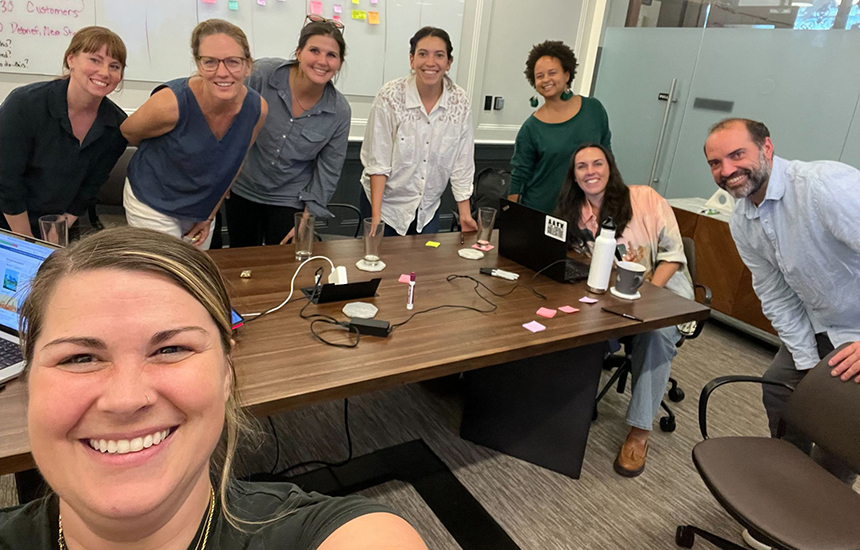 Adre team with The Impact Collective going through a B Corp Assessment. Sarah Holdman, The Impact Collective; Madeline Kovacs, Catherine Townsend, Jackie Santa Lucia, Anjelica Rivas, and Anyeley Hallová, Adre; Rebecca Goldcrump, The Impact Collective; and Joe Swank, Adre.
Adre’s Williams & Russell campus project is impressive for its goal of energy independence (via a microgrid) while creating affordable housing and business support for those impacted by displacement. How do you approach designing for environmental and social justice simultaneously?
For me, environmental and social justice are inseparable. Sustainability is now a baseline in development, but social equity must be intentional. At Adre, the goal is 30% of all development dollars, not just construction costs, to MWESB (minority, women owned, emerging small business) entities, ensuring communities historically excluded from development benefit directly.
We’re now scaling impact at the district level, aiming for energy sovereignty and financial independence for communities disproportionately affected by climate change and systemic economic extraction. Research on district-wide water, waste and energy systems began after Portland’s 2023 ice storm, when residents went without power for days, and followed a summer of extreme heat and wildfires. Neighborhood-scale solutions, like microgrids, can keep people safe and resilient, independent of the centralized grid.
Financial sustainability is equally critical. Affordable homes and rentable retail spaces allow residents and BIPOC-owned businesses to thrive long-term. By integrating climate resilience, financial equity and community empowerment, Adre’s projects demonstrate that people and the planet can and must thrive together.
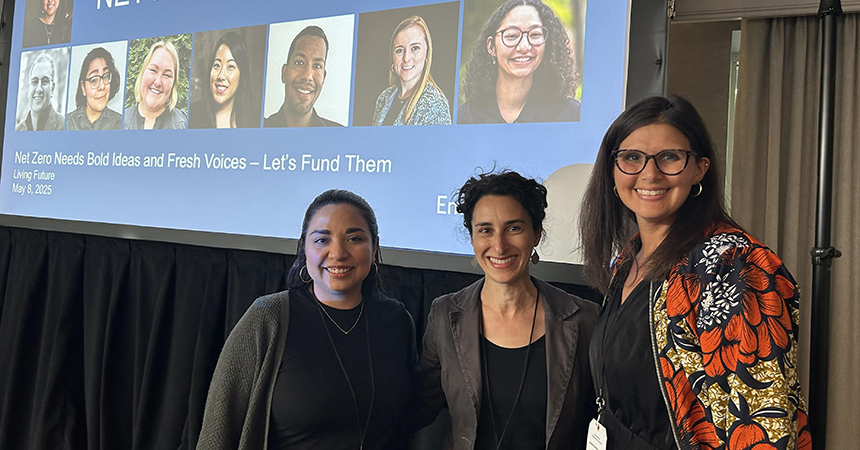 Presenting at Living Future about the Energy Trust of Oregon Net Zero Fellowship: Michele Montiel, Green Hammer; Naomi Cole, Konstrukt; and Jackie Santa Lucia, Adre.
You co-founded the Your Street Your Voice (YSYV) after-school program with Joe Swank and Audrey Alverson almost a decade ago, to introduce high school students to use design, buildings and infrastructure, as a tool for racial and environmental justice. What’s your design-teaching philosophy?
The big question we ask the students is: “If you could change one thing in your neighborhood through design, what would it be?” Students always have an answer. We coach students to develop their ideas, generate drawings and present their projects. We teach them about the physical and social systems in the city, and dive into how density, gentrification, climate change and policy impact our buildings and community.
How do you envision the intersection of architecture, renewable energy and community development evolving over the next decade?
We are in an incredible era in Portland for reparative projects. And seeing the future of our places in the making. My hope is that we can future-proof buildings at all scales, resulting in agency for communities. A lot of people don’t know that buildings are not designed to withstand a climate disaster – they’re designed to stay safe for an hour or two for people to vacate the space. However, there are resilient hubs being built to withstand wildfire, earthquakes and floods. My hope is that all buildings last a lifetime, are regenerative going forward and have real cultural, social and economic impacts that support everyone.
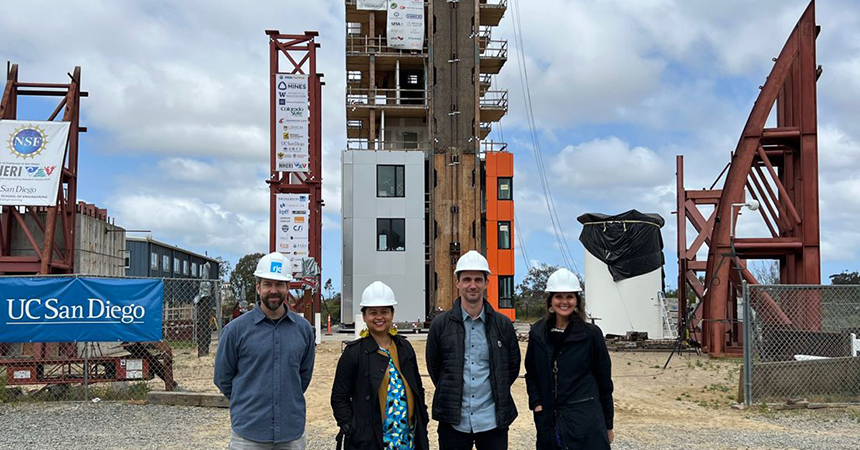 Onsite as part of the Shake Test for Mass Timber Rocking Wall, which is basis of design for the Killingsworth Resilience Hub. With Eric McDonnell, Holmes, Anyeley Hallová, Adre, Jonathan Hepburn, LEVER and Jackie Santa Lucia, Adre.
Looking back, what advice would you give your younger self, starting out in your career?I’d tell my younger self to lean into your curiosities, no matter how “nerdy” they seem. I used to hide my fascination with buildings, worried it wasn’t cool. But, sharing your interests is how the right people find you. Go to lectures, ask questions and connect with those doing work that excites you. Putting yourself out there builds skills, relationships and attracts the mentors and experiences that shape your path in ways you can’t yet imagine.