
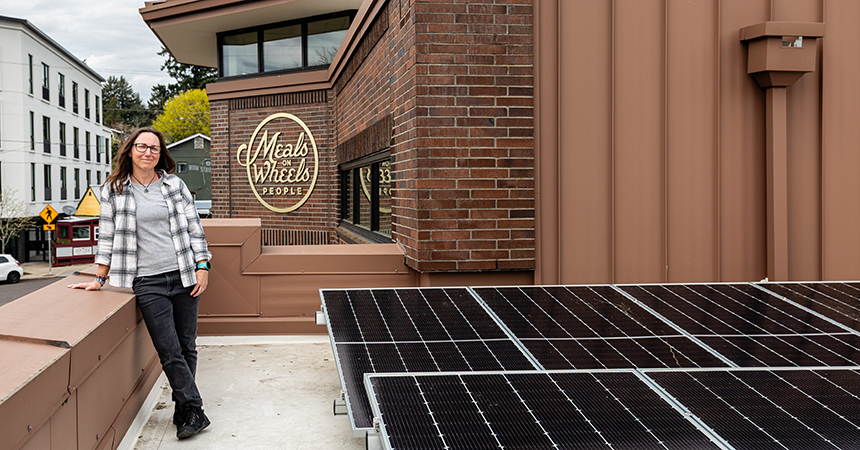
With the installation of a new solar and battery storage system, Meals on Wheels People is demonstrating how nonprofits can install renewable power to significantly reduce energy costs and also advance sustainability and resilience goals. The savings will go directly toward their mission of serving more than 28,000 meals each week to older adults across the Portland area.
“The money saved can just go straight back into operations and meals. It’s just such a win for our organization,” said Kristin Mueller, Meals on Wheels People senior administrative project manager.
Founded in 1970, the nonprofit serves nutritious meals at 14 dining centers in Multnomah, Washington and Clark counties, and volunteers deliver nourishment and connection to homebound older adults who are isolated or at risk.
Energy Trust of Oregon cash incentives, combined with other funding, helped make this renewable power project possible at the organization’s Westside Resource Center in Portland’s Multnomah Village neighborhood.
“We use a massive amount of electricity at this site running a commercial production kitchen that makes 1.5 million meals a year. Our electric bills were $8,000 a month,” said Mueller. They anticipate solar power will reduce bills by about 24 percent, saving an estimated $23,000 annually.
The nonprofit had previously worked with Energy Trust on several energy-efficiency improvements, including an LED lighting upgrade, at the Westside Resource Center.
When Meals on Wheels People built up an electric vehicle fleet to support food delivery, they began to consider adding solar panels to the building, which houses administrative offices as well as the central kitchen.
“We realized we could really make an impact by creating our own power source. When this building was built, they designed it to have solar on the roof, but it was too expensive,” said Mueller, “The building has just been waiting for solar. We saw this as an opportunity to generate so much electricity in a clean way.”
They turned to Neil Kelly, an Energy Trust trade ally, whose president, Tom Kelly, served on the Meals on Wheels People board of directors at the time. Tom suggested pairing the solar with battery storage to do even more. Large batteries can store excess power produced by solar panels for future use.
“We thought it would be amazing to have backup for power outages that’s not a diesel generator,” said Mueller. “It’s loud, it’s creating diesel emissions in our neighborhood and it’s gross.”
Solar + storage saves money
The 81.7-kilowatt solar installation came online in February 2026. It’s generating an estimated 92,000 kilowatt-hours of electricity annually, which charges up the 256-kWh battery storage system — one of the largest in Portland to date.
The solar energy helps offset their energy usage including electric vehicle charging. Plus, the organization draws on the clean power from their battery storage when firing up the kitchen for daily meal preparation. By using the battery during peak periods like this, they manage demand charges on their electric bill to save even more money. The solar panels recharge the battery later in the day.
If a power outage hits, the battery storage automatically backs up the center’s freezers and coolers, protecting thousands of dollars’ worth of food. Preventing food loss ensures that Meals on Wheels People will be ready to jump back into action and serve vulnerable communities as soon as the outage is over.
Stacked funding, Energy Trust trade ally makes project possible
As a Portland General Electric customer, Meals on Wheels People is eligible for Energy Trust cash incentives. They have applied for an Energy Trust increased cash incentive for nonprofits totaling $120,000 to help cover the cost of the solar installation, and also a $9,000 battery storage incentive. At the start of the project, Energy Trust supplied an $1,800 solar development assistance incentive to offset the upfront cost of a feasibility report.
“You really feel comfortable working through Energy Trust. It’s like, ‘okay, this is a feasible project’ — it’s been vetted,” said Mueller.
The feasibility report was a critical tool to help move the project forward and secure a large grant from the Portland Clean Energy Community Benefits Fund that helped cover installation costs.
As the nonprofit worked to secure funding, Mueller appreciated the collaboration with the project team. “It truly is a partnership that has this value that you can’t even put a price tag on — having contractors you trust, who are patient and will go the extra mile on grant requirements.”
Now the organization is applying lessons learned from this project to open a new facility on the east side of town later in 2026. Designed with an even more robust solar plus storage system, the new building will also serve as a community resilience hub.
“Our goal is to never have a waiting list. We have never turned away anybody who needs a meal. We’re all feeling the pressure of a growing older adult population, with more service needs, and a more chaotic funding environment. We really need to, in every way possible, look for ways to fund our mission and save on expenses,” said Mueller. “The benefits of this system will continue year after year. It truly makes it us more sustainable — fiscally and environmentally.”
Mueller encourages other nonprofits and businesses to look into Energy Trust programs and incentives. “As long as you’re using resources, there are things you can do to reduce energy costs. There’s so much opportunity.”
Interested in learning how your organization can benefit from solar + storage? PGE and Pacific Power customers are eligible for Energy Trust cash incentives. Request a free analysis and bid.