
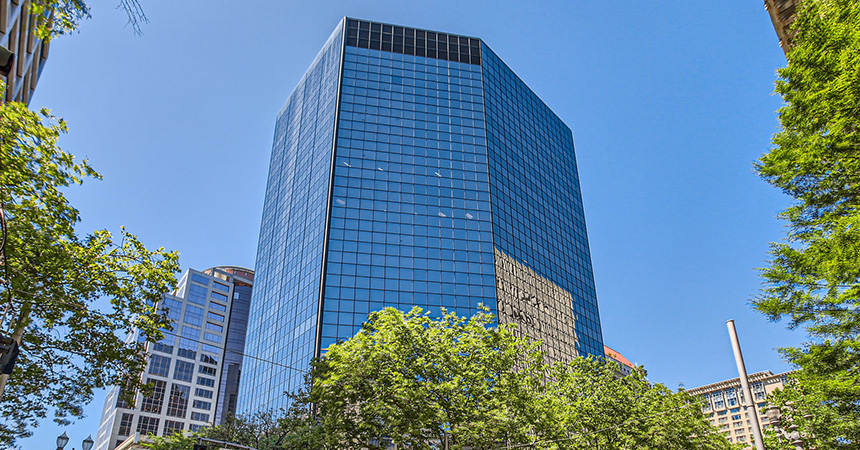
Sixth & Main is a 23-story LEED-EB (Leadership in Energy and Environmental Design – Existing Buildings) Gold certified high-rise office tower located in downtown Portland. Originally built in 1980, the building is home to many retail options, as well as dozens of business tenants and office spaces.
As Sixth & Main approached its 40th anniversary, much of the building’s HVAC equipment was nearing the end of its life cycle and in need of replacement. Within the decade leading up to the anniversary, Anna Pouliot, the building’s senior property manager, and Chris Robles, the chief engineer, had begun exploring HVAC upgrades to improve energy efficiency and provide more consistent cooling for tenants and visitors.
“I was actually very, very surprised that our old equipment was so inefficient”, Robles said.
Upgrades needed
The Sixth & Main system had a primary “pony” chiller to handle lighter loads and a secondary chiller to handle heavier loads. Over time, Sixth & Main’s HVAC system had begun failing due to both of these aging chillers that could no longer cool the building effectively. The primary chiller leaked so badly that the Sixth & Main team had to plug 70% of its tubes.
The HVAC system also relied on a hot deck fan and a cold deck fan working together to regulate temperatures throughout the building by mixing hot and cold air. By late 2023, the hot deck fan failed and eventually exploded. Pouliot and Robles quickly rebuilt the fan system. The system, using a variable pitch fan, was re-fitted with custom cut fan blades to maintain airflow. While this workaround kept the building operational for over a year, it became clear that the entire HVAC system required a major upgrade.
The combination of a severely compromised primary chiller, a temperature-limited backup chiller and a temporary solution for the fan system resulted in poor energy efficiency and inconsistent temperatures throughout the building. As a result, Pouliot frequently fielded tenant complaints about uneven heating and cooling.
“We need to have tenant comfort in mind. We do have actual people and their work lives we have to consider,” said Robles.
With tenant comfort as a top priority and failing temporary equipment in place, Pouliot and Robles were working on a compressed timeline to secure funding and move forward with equipment replacement.
Energy Trust of Oregon provides incentives
Given the size and potential cost of the project, Pouliot and Robles began looking for support to help deliver reliable, energy-efficient heating and cooling. That search led them to Energy Trust. Following a site visit from an energy advisor, Sixth & Main worked with an Energy Trust Allied Technical Assistance Contractor to conduct a technical analysis study that identified the most effective upgrade path for the building. As a result, they installed a new chiller, pumps, a cooling tower and custom Direct Digital Controls (DDC) system. Sixth & Main received almost $114,700 in cash incentives and are expected to save up to an estimated $41,500 annually in energy costs.
“One of the biggest successes that we have seen is the vast reduction in our electricity bill once we got the new chiller and the new fan wall in place. Right now, we’re trending 30% under budget in electricity alone.”
Anna Pouliot, Sixth & Main
As an added benefit, the DDC system uses sensors and software to continuously adjust temperature, airflow and schedules, keeping the building comfortable and operating efficiently. The new controls reduced the need for manual HVAC equipment adjustments from Robles and his team.
“Upgrading the controls gave us a lot more visibility into how to control the building,” Pouliot said.
Thanks to their partnership with Energy Trust, Sixth & Main now receives consistent cooling from its new HVAC system, something the building and its tenants had not experienced in more than a decade. Energy-efficient building upgrades can help businesses save money on energy bills while improving comfort for tenants and occupants.
Learn more about how your building can save energy with support from Energy Trust. Visit the cash incentives page or get started on your energy-saving project by emailing existingbuildings@energytrust.org.