
In the rolling high desert east of Klamath Falls, the Langell Valley Irrigation District manages more than 16,000 acres of farmland near the town of Bonanza. For Executive Director Shane McDonald, the biggest challenge isn’t just moving water—it’s doing it efficiently, safely, and affordably in a region where both energy and water are under pressure.
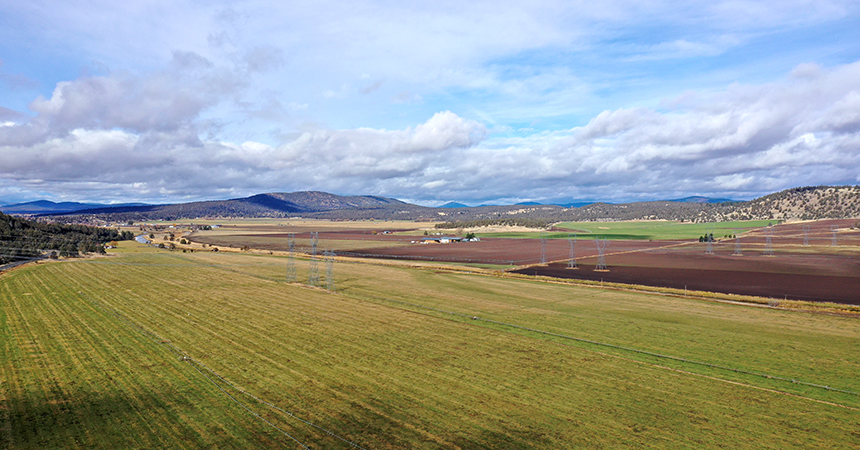 Irrigated farmland in Langell Valley, near Bonanza Oregon
“Power is usually our largest budget item,” McDonald explains. “So I’m focusing on power and water conservation on our pumped lines.”
With support from Energy Trust of Oregon, the district recently installed its first variable frequency drive (VFD), a motor controller that allows pumps to deliver only as much power and water as needed, rather than running full speed all the time. The results were immediate: lower bills, fewer overflows, and safer, more reliable irrigation. As Shane continues to work with Langell Valley, he sees more opportunity to install VFDs, improve existing systems, and to pipe and enclose much (but not all) of the open irrigation canals.
Controlling costs and conserving water
Before the upgrade, pumping was an all-or-nothing process. If 200 horsepower was too much and 100 wasn’t enough, operators had to live with wasted energy and water. “Now we can adjust the VFD to exactly what we need instead of just turning on the 100 horse and trying to find extra areas of water,” McDonald says.
That precision prevents costly water losses. In the past, excess flow often spilled into drains or rivers, wasting thousands of gallons and creating extra labor for staff. With the VFD, the district delivers closer to the actual demand, saving both time and water.
Investing in the future
The first project, completed in 2025, cost about $13,000, with Energy Trust covering nearly three-quarters of the expense through over $9,700 in cash incentives. The investment is expected to pay for itself in about three years, with more than 21,000 kilowatt-hours of electricity saved annually and over $1,700 in annual energy cost reductions.
But for McDonald, this is just the start. In his experience, irrigation districts can be slow to upgrade, because investments have to make sound economic sense. “We’re working toward automation. Right now, we’re still in the 1900s,” he jokes. After updating basic infrastructure, he notes “the next step will be alarms that come to our phone. Then, someday, sensors throughout the canals that can allow us to adjust flows remotely, or automatically. Eventually, we’ll get to the 21st century.”
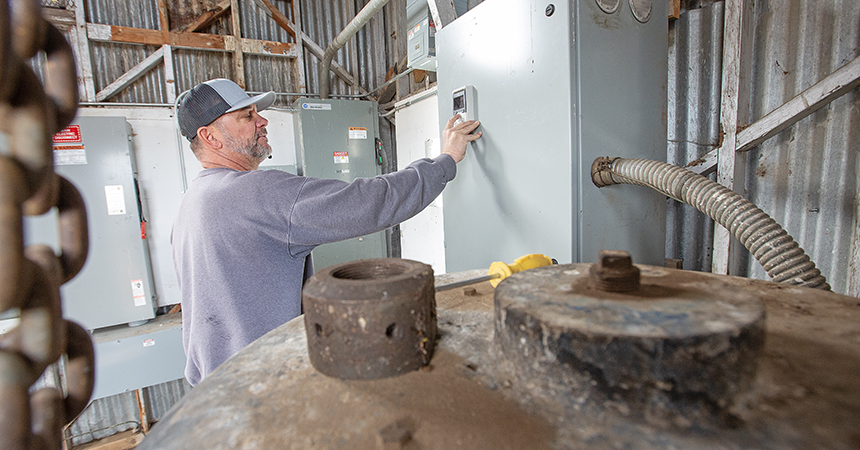 McDonald adjusts the recently installed VFD at a pump station
More than energy savings
Beyond lower bills and better water control, the VFD also reduces labor demands, allowing workers to focus their time and effort elsewhere. Fewer spills and emergency repairs mean crews spend less time chasing down problems and more time keeping the system running smoothly. “Everything we’re doing from here on out will improve labor efficiency, power and water use,” McDonald says.
The district now plans to pursue additional VFD installations on larger pumps, along with long-term improvements such as piping canals, lining ditches to reduce seepage, and exploring innovative micro-hydro opportunities using historic infrastructure.
A model for rural irrigators
Langell Valley’s experience highlights how even modest upgrades can ripple outward across entire communities. With Energy Trust’s support, the district is proving that irrigation modernization can save money, conserve scarce water resources, and create a safer, more resilient system for the future.
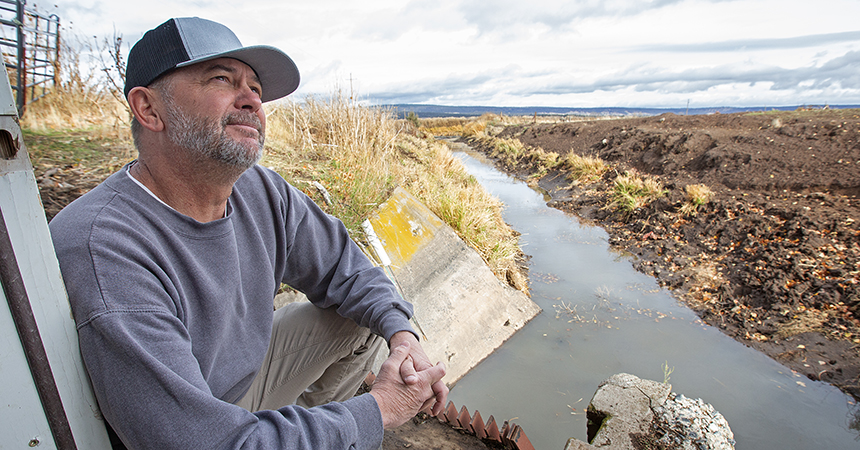 McDonald inspecting the water level and debris rack at a pump station
McDonald encourages other irrigation districts to consider similar projects. “Anybody can save and afford 25% of a VFD if you really try,” he says. “The support from Energy Trust makes these projects possible. It’s a great partnership, and we’re just getting started.”
Key project results:
- $13,369 total project cost
- $9,781 in Energy Trust cash incentives
- $1,728 in estimated annual energy savings
- 21,735 kWh saved annually
- Three-year payback, 15-year equipment life
Learn more about Energy Trust’s technical support and cash incentives for irrigation improvements at www.energytrust.org/irrigation.