
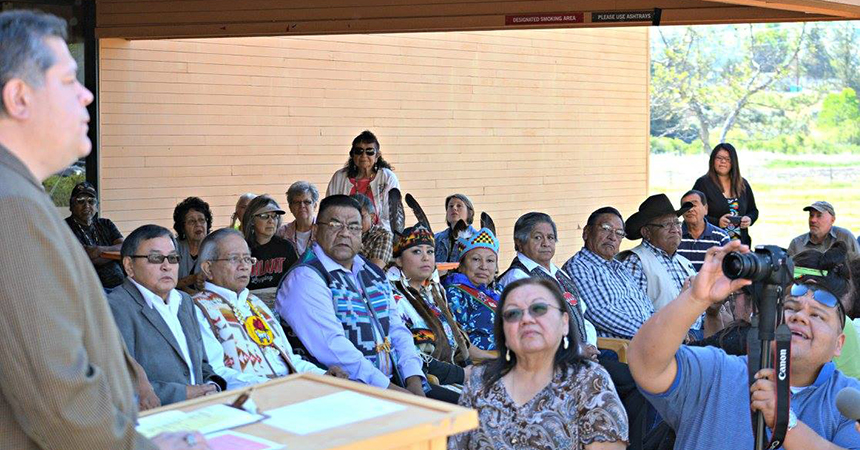
Carina Miller (front, center row) attends the Confederated Tribes of Warm Springs’s 27th Tribal Council swearing-in ceremony, where community members gather to witness and support the newly appointed council leadership.
As part of its work to support and engage Oregon’s Tribal governments and members, Energy Trust hired its first Tribal government and stakeholder relations manager, Carina Miller.
Miller, who joined Energy Trust in 2025, is an enrolled member of the Confederated Tribes of Warm Springs where she served on Tribal Council and is currently chair of the Columbia River Gorge Commission. Energy Trust is committed to improving service and delivering direct benefits to Tribal customers and communities. While doing so, the organization also ensures that its engagements and relationships are responsive and respectful of Tribal governments’ traditions, values and governance practices. Carina serves as a convener and facilitator within Energy Trust, advising the organization on its understanding of and engagement with Tribal governments and communities.
Question: How do you describe your role at Energy Trust?
Carina Miller: As Energy Trust builds relations with tribes, it is essential that we understand the history and connection Oregon Tribes have to energy, energy efficiency and renewable energy. The energy landscape in Oregon is intricately linked to the history and culture of its Indigenous peoples.
Question: Can you tell us more about the connection Tribes have to energy in Oregon?
Carina Miller: The loss of Celilo Falls in 1957, submerged by the construction of the Dalles Dam, marked a significant turning point for Indigenous communities along the Columbia River and the social norms and lifeways that existed consistently on the land since time immemorial. This loss devastated traditional fishing practices and erased a sacred site, illustrating how energy needs often came at the expense of tribal rights and resources.
Question: How did this impact the Confederated Tribes of Warm Springs, of which you’re a member?
Carina Miller: In the decades that followed the loss of Celilo Falls, the Warm Springs Tribes began to assert their sovereignty and engage strategically in the energy sector, setting the stage for a new chapter in their history.
In the 1960s, the Confederated Tribes of Warm Springs began to engage actively with energy markets and utilities, responding to the challenges and opportunities presented by the Round Butte Dam project, completed as three separate hydroelectricity dams in 1964 on the Deschutes River, Crooked River and Metolious River and developed by Portland General Electric. The project, while providing hydroelectric power and supporting regional energy needs, also disrupted traditional fishing practices and ecosystems vital to the Tribes’ cultural heritage. Recognizing the economic potential of energy production, the Tribes sought to assert their sovereignty by negotiating partnerships with utilities and the Federal Energy Regulatory Commission. These negotiations aimed to create revenue streams that would allow the Tribes to benefit from the energy generated by the dam while also advocating for environmental considerations, such as restoring fish populations affected by the dam’s construction.
This led to the establishment of the Warm Springs Power and Water Enterprises in the 1990s and highlighted the importance of balancing economic development with cultural preservation.
“By navigating the complexities of the energy sector, the Confederated Tribes of Warm Springs have continued to reclaim control over their resources, demonstrating resilience and commitment to sustainable practices that honor their heritage while keeping them at the table.”
Carina Miller
The Warm Springs Power and Water Enterprises operates as a critical revenue-based engine for the Confederated Tribes of Warm Springs, generating approximately 70% to 80% of the tribal government’s annual funding for essential services like healthcare and education. Unlike municipalities that rely on a tax base, Warm Springs Power and Water Enterprise leverages the Tribes’ ownership in the Pelton Round Butte project as a foundation to fund its sovereignty.
Question: How did the Tribes ensure they received benefits from the development of the hydroelectric dams?
Carina Miller: This current status is the culmination of a strategic vision set in motion by Tribal leadership in the 1950s and 1960s. When the project was first authorized, the Tribes secured an 1855 Treaty-based “exclusive right” to future power generation at the site if it ever became feasible. This foresight allowed the Tribes to pivot from being mere landlords receiving rent to becoming an equal partner with PGE in 2001. Today, the Tribes are the majority owners of Pelton Round Butte, a transition that effectively uncouples Tribal prosperity from changes in federal leasing. While the Warm Springs Power and Water Enterprises manages these massive energy assets to transmit to Portland General Electric customers, the electricity provider for local homes and buildings is Pacific Power.
To prevent environmental interests from continuing to be secondary to energy production, the Tribes have forged powerful alliances with groups like PGE and federal agencies, investing millions into the Selective Water Withdrawal intake system at Pelton Round Butte Dam. This technology has successfully restored fish passage for the first time in over 50 years, with recent data showing over 900 adult steelheads returning to spawn in the Upper Basin.
Historically, federal policy has dictated tribal economies, often forcing a choice between economic survival and natural resource protection — a binary that does not align with tribal values. By integrating cultural priorities with utility operations, Tribes ensure that the protection of salmon and earth remains a primary management pillar.
Question: What are the most important energy issues facing Tribes today?
Carina Miller: While the Tribes are power-generation giants, individual members face a mounting affordability crisis. In 2025, residential Pacific Power customers in Oregon saw a 9.8% rate increase For residents in Warm Springs, the average residential rate sits at approximately 13.77¢/kWh—slightly lower than the state average of 14.91¢/kWh — yet the “energy burden” remains disproportionately high. Because tribal households often use a higher-than-average proportion of their income on utilities due to extreme seasonal temperatures and older housing stock, these rate hikes hit the reservation harder than urban centers.
The capacity required to manage these resources is staggering. The Tribes do not just oversee the land; they manage thousands of acres of ceded lands and watersheds with a sophistication that often outpaces federal agencies. For instance, the Tribes and PGE have invested over $108 million into the Selective Water Withdrawal system to restore salmon passage. Additionally, the new Salmon Fly Solar Project is set to bring 250 MW of renewable capacity and battery storage to the reservation by 2027, requiring millions in capital and a highly specialized workforce.
However, a stark disparity exists in how this work is funded compared to social needs. While energy projects generate the revenue used to support the community, the natural resources budget – which includes protecting water quality and salmon across the Deschutes and John Day basins — often relies on competitive federal grants for a fraction of the enterprise’s revenue. In contrast, the health and human services and education budgets are under constant pressure from federal policy shifts. In 2024 and 2025, Northwest Tribes faced potential cuts of nearly $530 million in federal funds meant for essential services. Tribes are often dedicating resources and capacity to land management, directly impacting our ability to support our community.
Question: What is most important for Energy Trust to understand when working with Tribes?
Carina Miller: True progress requires a deeper understanding of these complexities to bring the specific support needed at every level. We must support the Tribal Government in its legislative sovereignty, the Enterprise/Tribal Utility in its technical and market expansion and the individual Tribal member in their connection to energy efficiency and renewable sources. Though the scale of these needs differs, they are all vital threads of the same braid, woven together to ensure that the river, the power and the people remain inseparable and resilient.
Question: Are there resources available for people who want to learn more?
Carina Miller: Yes. The Oregon Historical Society has some information on the Round Butte Project and so does the Hydropower Reform Coalition. Warm Springs Power and Water Enterprises is a great resource. PGE also has information about the Pelton Round Butte project. I also recommend this article in The Bulletin on the Salmon Fly Solar Project.