
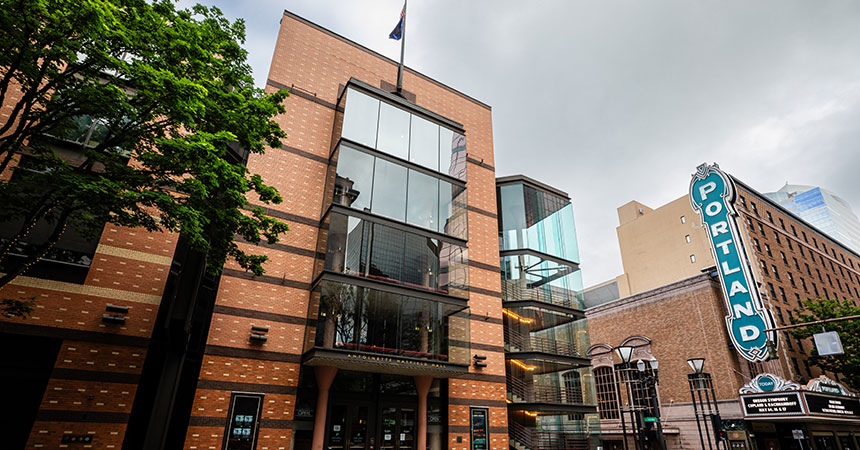
As facility manager for Portland’5 Centers for the Arts, Leslie Smith is responsible for operating and maintaining beloved and historic performance venues. Her role includes keeping buildings running smoothly, managing maintenance needs and supporting daily operations.
Recently, she learned about Oregon Department of Energy’s Building Performance Standard (BPS) requirements through participation in Energy Trust programs.
BPS is a state law intended to reduce energy use in large commercial buildings. Many commercial buildings over 20,000 square feet will be required to track and report energy use and work toward specific Energy Use Intensity (EUI) targets. Deadlines begin as early as 2028, making it important for building owners and operators to understand BPS compliance requirements and begin taking action.
Through an Energy Trust energy advisor, Smith learned about Energy Trust’s BPS Pathway, which provides guidance, technical support and an action plan to help participating businesses understand BPS compliance requirements and identify opportunities to improve building performance.
Once Portland’5 Centers for the Arts, a customer of Portland General Electric (PGE) and NW Natural, began participating in BPS Pathway, Energy Trust energy coaches worked with Smith and her team to better understand how the buildings were performing. Support included reviewing building systems and identifying opportunities for efficiency improvements, creating an action plan to reduce energy use and providing ongoing coaching and technical support.
As part of the process of identifying opportunities for efficiency improvements, energy coaches conducted a treasure hunt, which included:
- Walking through the buildings with energy experts to observe equipment and operations in real time
- Looking for energy saving opportunities staff might overlook during day-to-day operations
- Identifying equipment upgrades that could qualify for cash incentives
“The treasure hunt was a valuable experience to be able to slow down and just focus on details that get overlooked in the day-to-day. You can walk through a room a million times a month and just miss something that’s sitting right in front of you if that’s not what you’re looking for.” – Facility Manager Leslie Smith
During the treasure hunt, Smith and the team identified opportunities for operational improvements that could help reduce energy use, improve building performance and support progress toward BPS energy use targets, including:
- Stopping variable frequency drives (VFDs) from running continuously at 100%
- Turning off lights, adjusting light levels, or replacing inefficient fixtures with LEDs
- Optimizing VFDs on two large air-handling units
- Correcting building automation systems (BAS) programming and controls issues
- Addressing a malfunctioning CO2 sensor
“Energy Trust has been a significant help to us in identifying cash incentives or ways to make projects cover the difference to save energy and money and meet BPS requirements,” said Smith. “It’d be difficult to do all of this on your own without the support of the mentors of the BPS Pathway offering.”
Beyond identifying energy-saving opportunities, the BPS Pathway offering helped Smith and her team better understand the process and develop a strategy for moving forward.
“Energy Trust made things significantly easier and the process a lot smoother for us than it would have been otherwise,” Smith added.
Learn how Energy Trust can help you better understand and meet Oregon’s Building Performance Standard requirements. Email us or call 1.866.605.1676 to get started.