
Briar Wray came to the Pacific Northwest by way of Arizona 14 years ago, in search of a career in sustainability. Today, she is associate dean of sustainability strategies at Portland Community College (PCC), where she leads college-wide sustainability programming and implementation of PCC’s Climate Action Plan. She previously served as the college’s sustainability manager and sustainability analyst and currently sits on the Multnomah County Advisory Committee for Sustainability and Innovation. Wray has also taught sustainability courses at PCC and co-founded the Greater Portland Sustainability Education Network. She holds a Master’s degree in Sustainability from Arizona State University, along with a B.A. in Sustainability and a B.S. in Justice Studies.
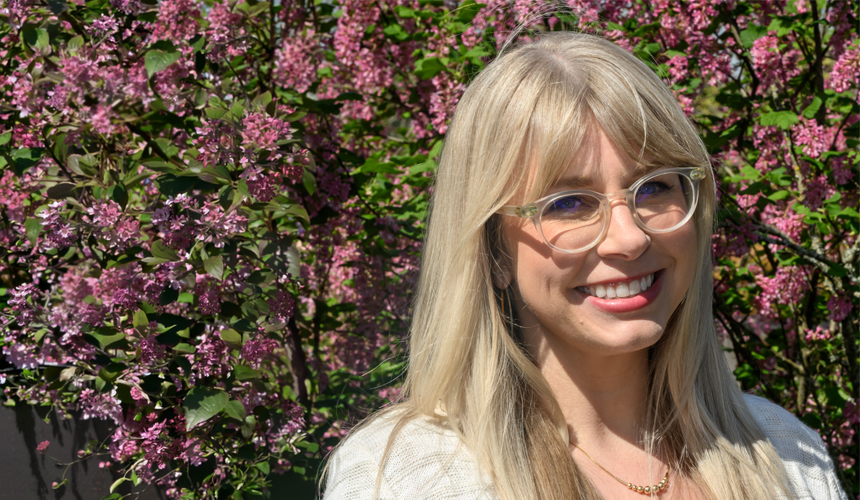
Tell us about your professional journey. What brought you to Portland from Arizona, and how did that lead to your career in sustainability at PCC?
I grew up in Arizona and went to college there. But in 2012 there weren’t a lot of entry-level jobs in sustainability in Arizona. I was ready for a change, and I knew there would be more opportunities in the Northwest. I took a gamble and moved here before I had a job. I sent out resumes every day. Three months later I got a job at PCC as a sustainability analyst and have worked at the college ever since.
I always knew I’d work in public service. My parents have backgrounds in social services and education. I was always drawn to impact-driven fields that help people and the planet.
You hold degrees in Sustainability and Justice Studies, plus a LEED Green Associate credential and a Master Gardener certification. How do those different threads inform how you approach your work?
The diversity in my education and professional development allows me to apply a holistic lens to my work. My academic training and career have focused on the triple-bottom-line of people, planet and prosperity, including racial and social justice, which brings a humanist perspective to my work. It really prepared me for my eventual role at PCC. I approach projects and programs with an equity lens for who is benefiting from the college’s programs and how our initiatives serve our communities. It’s been a dream come true to work at the cross-section of sustainability, education and public service.
Operationalizing sustainability and equity goals can be tricky, given that it requires change from deeply embedded economic systems and historical power structures. What does it look like in practice?
One major way I integrate equity and social justice into my work is by implementing PCC’s Climate Action Plan. This plan prioritizes equity and addresses historical injustices while working towards a resilient, thriving society with net-zero greenhouse gas emissions. At its heart, this means reducing climate burdens on our communities through green spaces and green energy, and making sure they have a voice that helps drive the work itself. It also means advancing climate education, green workforce development and supporting frontline community priorities.
How do you get district-wide buy-in on sustainability programs at a large, decentralized institution?
It can be tricky, but it helps that sustainability is a core value at PCC, and people genuinely care. However, we are often asking people to go above and beyond their job description with things like composting or adding reusable dishware into our dining program.
My team and I have it ingrained in us to build relationships that are mutually beneficial. We want to make sustainability as easy and streamlined as possible and make sure those who participate are aware of how it benefits them. We show up for folks as much as we ask them to show up for us. That has been the key to our success.
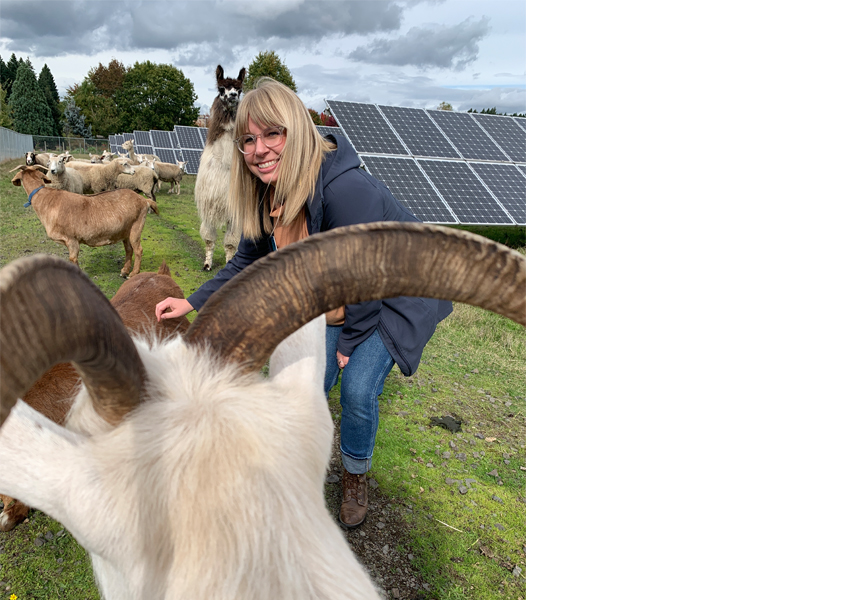 Wray at PCC’s Rock Creek campus, where solar panels provide electricity and goats contribute to carbon-neutral field mowing.
Is there an example of a sustainability initiative you piloted that was able to grow and become an institutional norm?
Ten years ago, my team and I visited every staff member, gave them a mini trash can and asked them to take out their own trash. It was a way to reduce waste, encourage more recycling and relieve custodial time that needed to be diverted to support composting and other duties. It wasn’t an easy ask, but I was the face of the program and talked with everyone that had concerns. The pilot became a district-wide norm that stands today.
As a college dean, does your work include helping to build a green workforce?
PCC is of course a major workforce educator in the region. I collaborate a lot with faculty about how we’re integrating sustainability into the curriculum. We’ve been getting a lot of requests from industry partners for workforce development that supports climate initiatives. Electric vehicles need mechanics who know how to work on them. Hydrogen power and mass timber projects need professionals to bring them to life. As our region considers what it takes to be climate resilient, we know we need industries, practices and the workforce to support it.
What advice would you give someone who wants to work in institutional sustainability?
I would say, keep your mind and your options open. You don’t have to have the word sustainability in your title to do the work and make an impact. There are so many mission-driven organizations that are tackling sustainability issues. Or you can bring your passion to a company that isn’t focused on sustainability and start a green team. There is a lot of necessary work that can be done without having a designated sustainability office. We need changemakers throughout all of society.
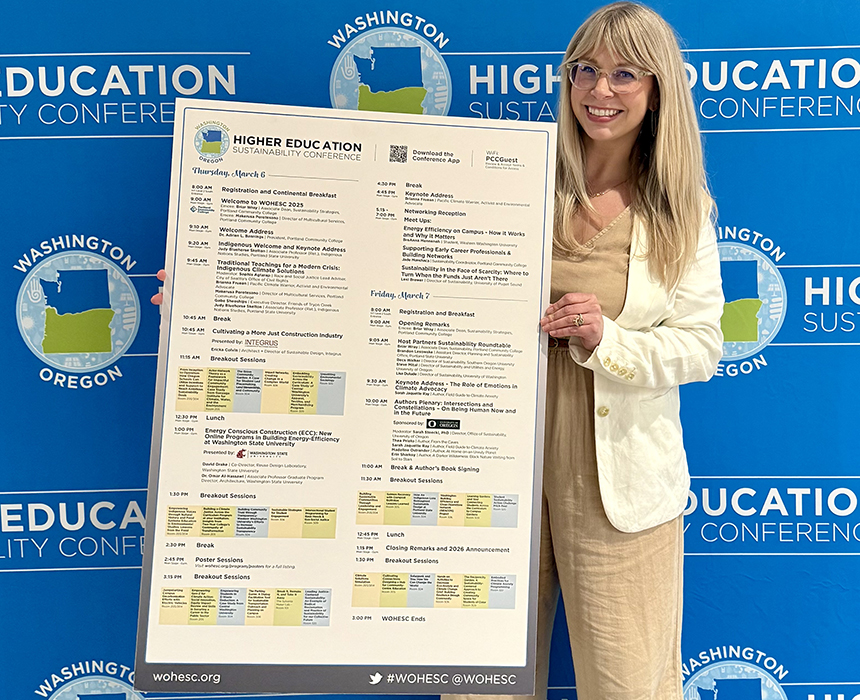 PCC hosted 450+ attendees for the Washington Oregon Higher Education Conference in March 2025. Wray sits on the planning committee for the annual conference and also emceed the event.
What gives you hope about where this work is headed?
Our students are truly what give me hope. I’m continually amazed by their knowledge, passion and commitment to all things sustainability and climate justice. They see the urgency and appreciate that the college has programs for them to learn and apply that knowledge. They are what gives me hope that we can shift the tide in favor of a more resilient, equitable and prosperous future!