
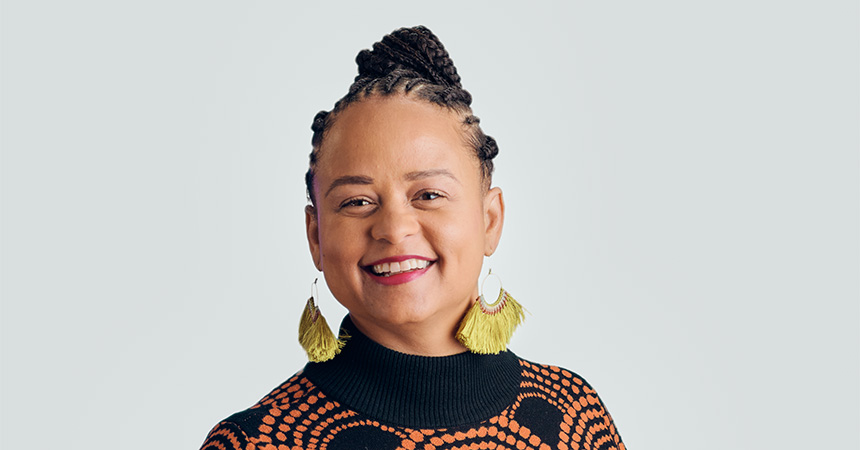
Anyeley Hallová is a real estate developer with over 20 years of experience in the built environment. She is the founder and CEO of Adré, a socially responsible real estate development company that creates ownership and investment opportunities for communities traditionally left out of real estate. Over her career, she has delivered $140 million in award-winning sustainable developments, spanning market-rate and student housing, retail spaces and offices for mission-driven organizations.
Her firm was recently honored with the Urban Land Institute’s 2026 Americas Award for Excellence for the innovative Parrott Creek project and was the smallest organization to receive this top international prize for real estate development. Hallová has spent the past five years working alongside Williams & Russell CDC to turn a vacant lot in the historic Albina neighborhood into a landmark reparative development. The development will feature 20 townhomes that will be owned by families with ties to the local community, as part of the Williams & Russell Project which will also include apartments, retail and space and a cultural plaza.
In 2021, Williams & Russell was still a design taking shape with LEVER Architecture. Now the project is moving forward, with home ownership becoming a reality for area residents. What’s it been like watching something you spent so long working towards on paper turn into a construction schedule?
It’s actually been 50 years in the making, after Legacy Health and the City of Portland worked together and took the property by eminent domain. The site sat vacant for 50 years. Before that, it was the commercial center of the former City of Albina.
For over a decade, many community members have been dedicated to transforming this site from vacant land, into an active construction project. I’m one of many in a lineage of community leaders making this vision a reality, and I want to shine a light on the advocates whose tireless work allowed me to join this effort five years ago to help realize this vision.
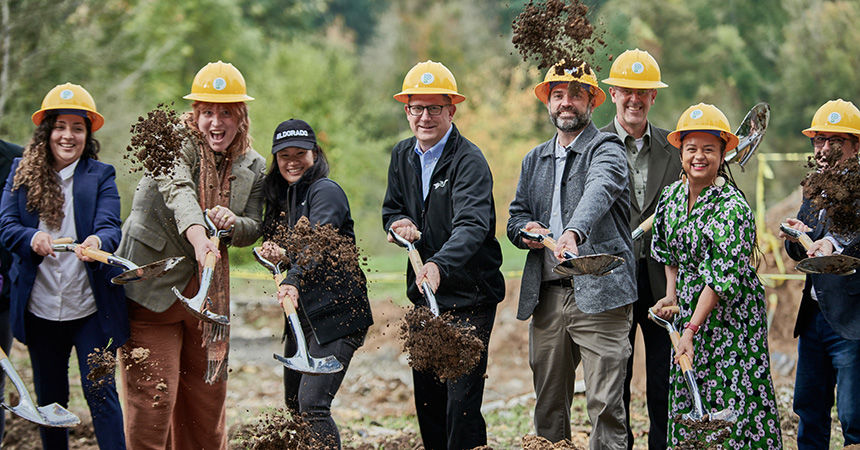
Hallová and colleagues at the Parrott Creek groundbreaking.
With mixed unit sizes, ADA-accessible ADUs, rooftop solar and an outreach process that shaped things like layout and outdoor space, this feels like a very intentionally designed project. What did you hear from the community that most shaped those design decisions? And how do you continue to make sure what you’re building is matching what people want?
When I first started Adre, I knew I wanted to do intentional projects in the community, including affordable home ownership. I wanted to know what Black community members wanted, so that if we’re building in a historically Black neighborhood, it would reflect what the community wants in their homes.
Before this project, I teamed with Arrive (formerly Portland Housing Center) to do a Black home buyer preference survey of potential first-time buyers. The feedback from the 140 respondents showed strong preferences for backyards, three-bedroom homes, and inner NE Portland locations, with affordability and market competition noted as key barriers.
After winning the project, we also did three community design-focus workshops with people who have historical ties to the neighborhood. We wanted to know everything: their preferences for interior and exterior colors, and the layouts and features of the homes. The project design was shaped with the community’s desires in mind – from the initial survey to the workshops. The result is that every townhome includes a private backyard and the ability to park a car, and most have three bedrooms.
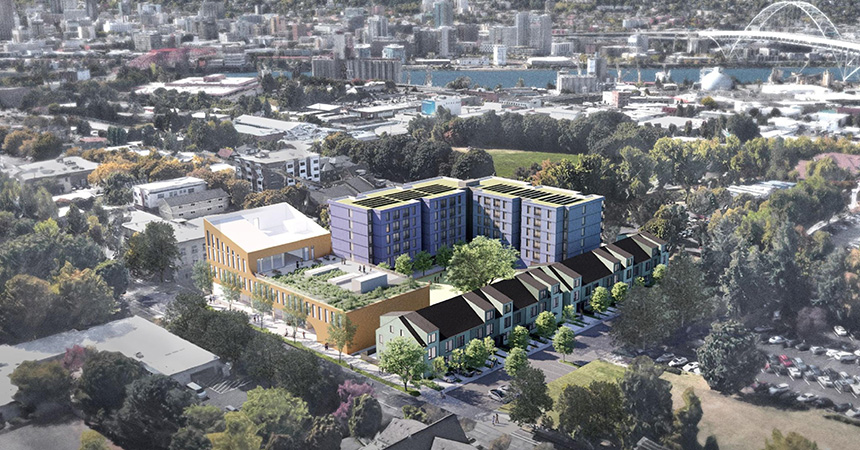
An aerial rendering of the Williams & Russell project.
The Williams & Russell site sits on land where structures were demolished for a hospital expansion that never happened. What does it mean to you to be part of rebuilding on that site for Portland’s Black community?
I’m honored to be part of this chapter of the project, and part of the team that pushed to get the site cleaned up for the people who’ll live, work and visit there. When we dug into the site’s history, we found it was heavily contaminated. The buildings that once stood there, including a paint shop, dry cleaner and a gas station, had simply been demolished and buried in place. Cleaning it up meant excavating up to 14 feet down and hauling all of that soil to a landfill until the site got a clean bill of health from the state. The remediation alone cost $8 million. That was just to get to the point of having healthy land to build on.
The City of Portland’s Clean Energy Fund () helped pay for things like better building performance. Has this funding pushed your design choices on the project?
I always want to do the most environmentally responsible thing I can with the resources I have. I also want to leave the homeowners with a financially beneficial asset that includes reduced energy costs. PCEF dollars allowed us to include energy-efficient windows, insulation and solar for the 20 townhouses. Not only will most of the homes have a major reduction in energy expenses, but 16 will be selling energy back to the grid. Together, the solar array meets 104% demand for the project. Each home is also EV charging-ready. This funding made it possible, and the benefits are going straight to the homeowners.
Your Net Zero Fellowship research framed the Williams & Russell Project as an eco-district (an area that applies sustainable practices at a neighborhood scale) with an energy microgrid. Were there hurdles in designing an eco-district that the research helped solve?
The fellowship was amazing, as it allowed us to explore the microgrid idea without having to make it happen. We really took it as a research & development project, but with a real client on a real site, to envisage the obstacles we might face if we tried to create an eco-district. The research was based around how a microgrid would interface with and between the three projects, what the utility company would have to do to allow a microgrid, and whether it would be possible for the nonprofit site owners to manage it over time. It also allowed us to understand the energy production capacity of the site. The research informed this and future projects, and we’ve shared our findings with the industry at large. Knowledge sharing and innovation are part of Adre’s company values and industry change is a part of our mission.
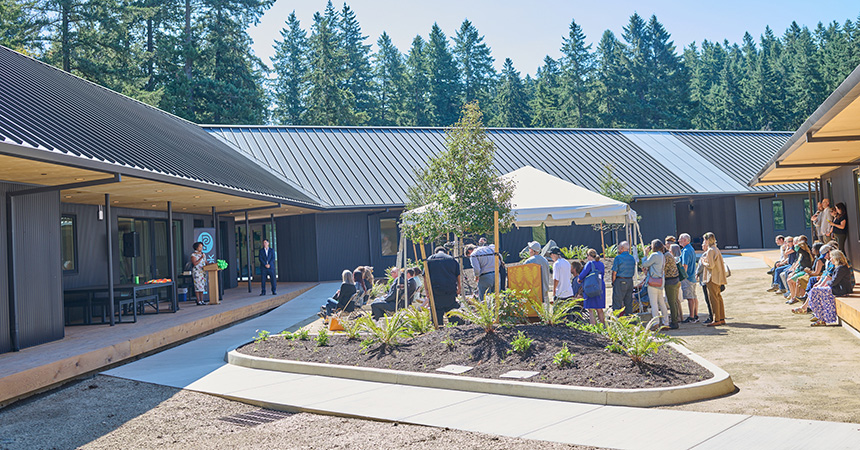
Hallová addresses attendees of the Parrott Creek ribbon cutting.
If another developer wanted to emulate your community-first, equity-centered approach, do you think it could travel well to other cities?
Part of Adre’s purpose is to create first-of-their-kind projects and concepts that can travel anywhere. Our work is meant to be inspirational, and it’s common for developers to share learnings among our community.
Oregon has always been great at innovation, especially around sustainability. We have the right mix of people collaborating and dreaming up new ideas, backed by smart government standards on land use and energy. That makes this a natural home for investment by grantmaking institutions – I’d love to see more of them invest here because we know how to make great things happen. My hope is that our local innovations benefit folks here in Oregon first, and once we prove that technology, we can share and export these best practices.
How will you know that the project is a success?
I think success happens on three levels: the community-driven design and collaboration process, the building itself delivering on high quality and sustainability, and fostering healthy future residents and workers – through home ownership, greater energy efficiency, community spaces, and building materials and tech that protect people from environmental hazards like bad weather and poor air quality.
What do you hope other developers or cities take from this framework when they’re planning affordable, equity-centered developments?
My work extends beyond building innovation to changing how development actually serves communities of color. I hope more developers become intentional about working with communities who’ve historically been left out, because they deserve the very best. These community-driven projects can be a lot harder to pull off than an office building with a massive corporate budget, but communities of color deserve that same level of investment and care.
Photo credit: Jason Hill