
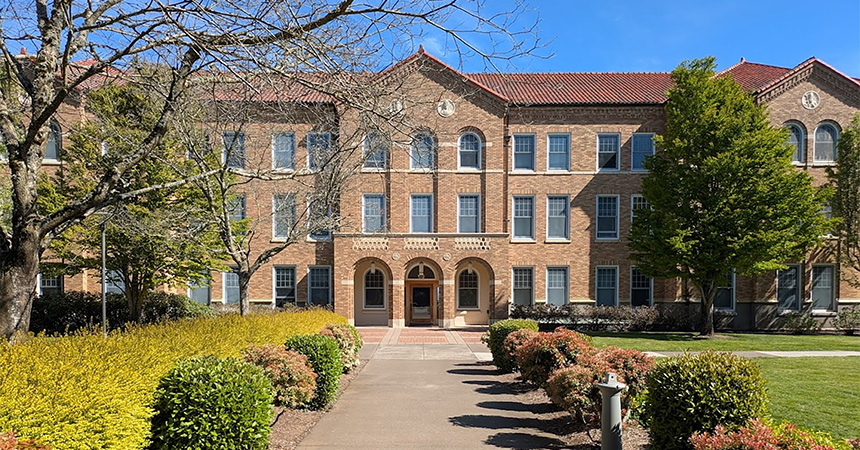
Nestled in the rolling hills of the Willamette Valley, Mount Angel Abbey is a Benedictine community founded in 1882 by monks from the Abbey of Engelberg in Switzerland. Today, the Abbey operates more like a small town than a single monastery building, and includes a seminary, library, post office, kitchen, brewery and multiple campus facilities that all require constant upkeep. For Facilities Project Manager Allan Graves, that means overseeing the daily upkeep of numerous properties across an aging complex of buildings.
“It’s like a college campus or small city,” Graves said. “We have our own post office and zip code. There’s over 100 or so people that live here full time. It’s kind of like what cities have to do in maintaining their properties, 24/7.”
Before moving into his current management role, Graves started at the Abbey in maintenance, where he saw firsthand how deferred maintenance and outdated mechanical systems affected the performance of multiple buildings.
One example was Aquinas Hall. Built in 1930, the building’s HVAC system had fallen into a nearly non-operational state, with failing controls and an outdated pneumatic system. “The HVAC system was basically in a non-operational state. The control units had died, so everything was left on its own,” Graves said.
Connecting to Energy Trust of Oregon
After seeing how unreliable the system had become, including the inability to monitor heating and fresh air circulation, Graves began looking for a solution. He was then connected to Energy Trust through the Abbey’s director of operations, who introduced him to existing Technical Analysis Studies (TAS Report) Energy Trust had conducted at Aquinas Hall, including potential efficiency upgrade recommendations.
“I then explained to them what I wanted to do, and they said, ‘There’s a perfect alignment here with where you want to go and what Energy Trust’s mission is,’” Graves said.
With support from Energy Trust, Graves upgraded Aquinas Hall’s HVAC system from pneumatic controls to direct digital controls. The project also replaced analog gauges and pneumatic control valves with digital components and upgraded obsolete control boards, giving the Abbey more precise, automated control over heating, ventilation and energy use.
Energy Trust cash incentives were paid directly to Robert Lloyd Sheet Metal, the trade ally contractor that installed the new controls, as a benefit to reduce the Abbey’s upfront costs by more than $22,000. In addition to lowering the upfront project cost, the upgrades are expected to save the Abbey more than $6,500 annually on energy costs.
“Energy Trust helped us identify, then get rid of all the pneumatic controls, and now we automate how we make use of the HVAC system,” Graves said.
Monitoring and managing systems
In addition to automating Aquinas Hall’s HVAC system, the upgrades made it easier for staff to manage and monitor room temperatures instead of guessing whether equipment is working properly. That added visibility is already proving helpful: Graves’ staff recently caught a circulation pump problem before it failed and was able to fix it early.
“We know exactly what’s going on every day,” Graves said.
The benefits go beyond automation, monitoring and energy savings. Energy Trust’s support also helps Mount Angel Abbey, a customer of PGE and NW Natural, advance its larger goal of being a good steward of donation-funded operations.
Graves said the project is also part of a larger effort to modernize systems across the campus and find new ways to improve efficiency.
“There are numerous projects I’m going to have in the pipeline,” he said. “This is just the beginning.”
Learn more about how you can save energy with support from Energy Trust. Visit our cash incentives page or get started by emailing existingbuildings@energytrust.org.