

This is a part of a series of blog posts amplifying community voices. These views reflect the perspective of the Changemaker and do not necessarily represent those of Energy Trust.
Mia Hocking grew up in Hillsboro in the 1970s, when it was a rural farm community. She embraced the outdoors and access to nature even as the area turned into the tech hub it is today. Conscious of waste streams from a young age, she began using found objects in her high school artwork — a medium she continues to use today when making visual art.
Professionally, Mia serves as resource conservation manager for the Hillsboro School District, where she recently oversaw a project that resulted in one of the largest incentive payments from Energy Trust of Oregon and actively champions clean energy initiatives. Her path into the field was one of genuine reinvention — drawing from a background in industrial safety before pivoting into energy management. Beyond her day-to-day role, Mia is secretary on the Board of the Association of Professional Energy Managers (APEM), contributing to the advancement of the field at an organizational level.
Can you take us back to where you grew up and what your relationship with the natural world looked like when you were a kid? Was conservation something you were aware of early on?
I grew up in Hillsboro. I’m the oldest of three daughters. It was a much more rural town then, in the 1970s. We lived near a farm, where I got to interact with the farm animals and the agricultural landscape. Our family vacations were also close to the natural environment — primarily tent camping, hiking and trips to the beach. We loved being outdoors.
I don’t think I ever thought of conservation as a concept or a profession, but I’ve always felt protective of the environment and the impact of waste. I have always felt at peace with our natural resources; they have been the inspiration of my artwork. By the time I finished high school, the big tech companies had come into Hillsboro, and the town was growing rapidly.
Was there a person or experience that planted the first seed of interest in energy or environmental stewardship for you?
In high school I was most inspired by found objects and natural materials to create art. My visual art still revolves around the repurpose of materials and giving life to items that are commonly discarded. In that way, sustainability, reusability and conservation have always been woven in the artistic side of my life. It was the concept of repurposing that got me to really look at waste streams.
I never thought about it as a profession, until my current role as a resource conservation manager. But I feel like my interest in environmental stewardship started in my childhood.
What did you study in school, and at what point did energy management enter the picture?
Well, I’ve been to college three times. In the 1980s, I went to the Pacific NW College of Art to study graphic design. About 20 years later I went back to school to get a business management degree.
From 2000 to 2007 I worked in a paper mill in St. Helens, Oregon, as an office manager and safety officer, which was a form of school in and of itself. I didn’t know anything about industrial pulp and paper, but I dove in and it was a great experience. Quite a bit carried over to my current role in Hillsboro, because I learned a lot about mechanical and electrical systems. I also worked with teams in maintenance and other trades — learned their language and learned about project management.
I found my way to the Hillsboro School District in 2009 as a school secretary before I became an office manager in facilities and maintenance, and then in 2018, I moved into my current job. Taking a career pathway that once again, I was completely new to. I decided to attend college again, at Lane Community College’s Energy Management program, which was directly applicable to my current role.
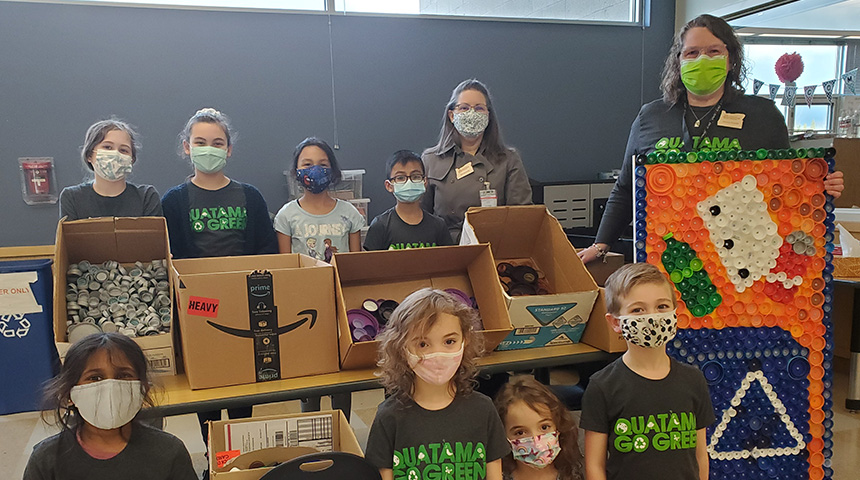
Mia working with recycled materials with the Quatama Elementary Green Team.
What does a resource conservation manager do, day-to-day, in a school district?
Every day looks different. It can be about recycling, gardening and maintaining outdoor spaces. It mostly involves analyzing data on building operations and energy usage. I also keep detailed records for the district’s inventory of properties — what kind of systems are in the building, the age and condition of the building, and maintenance costs so I can develop the utilities budget.
The Hillsboro School District has been enrolled in Energy Trust’s Strategic Energy Management (SEM) program since 2016. This program provides resources and coaching in low- and no- cost actions towards tuning up energy systems, leading to improved building performance. I consult with a team of SEM coaches monthly. They have provided invaluable expertise to my daily work. Over the 10 years of enrollment, Hillsboro School District has achieved about $900K in combined program milestones, incremental savings incentives and estimated utility savings.
I also work with the utilities to implement service changes and shut offs. And I train the custodial and maintenance staff on HVAC control systems and waste disposal programs.
You were involved in earning one of the largest incentive checks in recent history for existing buildings through Energy Trust. How did that project come together — from identifying the opportunity to seeing that check?
In 2023, one of our largest schools, Liberty High School, needed new HVAC system and boilers. Over its 20-year life, the building was becoming less and less efficient to heat and cool. The HVAC controllers were failing and were no longer replaceable. We could either replace the controllers with the next generation of that same brand and replace five boilers — or take the opportunity to put in a much more efficient and reliable system, even though the upfront costs would be quite a bit more.
The upgrades at Liberty High School have already delivered nearly $195,000 in estimated annual energy savings. While it ended up being a $2.2 million job, Energy Trust’s incentive was about $655,000 and the rest of the cost was covered by state funds. We were able to get these major incentives because the decrease in energy usage at the school was going to be so significant, and the building’s performance was going to go way up.
It’s been a valuable experience. School districts in eligible regions should take advantage of energy incentive opportunities. Energy Trust helps with the legwork during the process, and even if a project doesn’t pan out, they will organize energy studies so experts can take a look at how the building is performing, and those are usually covered by incentives.
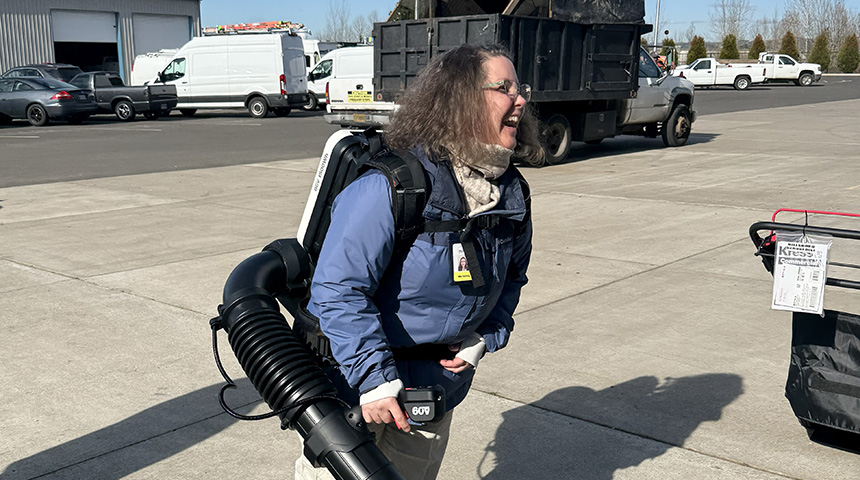
Trying out the Hillsboro School District’s new battery powered equipment.
What are the unique challenges of managing energy in school buildings, versus commercial or industrial settings?
Energy usage is not at the top of everyone’s mind and is usually viewed separately from day-to-day district operations, even though it’s essential. Generally, I think we all believe the lights and the heat will just come on; the toilets will flush and we don’t think much more about it.
As utility rates continue to increase, the importance of managing building performance becomes even more critical for health and financial reasons. For example, HVAC systems are the largest energy consumer in a building and adding more academic and community activities extends the hours the building is in use. At times only a fraction of the building is in use after school hours, but the HVAC system might be conditioning a lot more than the requested space due to system design limitations. This results in a lot of extra usage, utility costs and accelerated equipment depreciation.
Of course, the district supports community use of its spaces. HVAC and lighting systems are an integral part of achieving safe, secure and healthy learning spaces. We just need to bring awareness and understanding as we expand programming and availability of district buildings. Utilities are not an afterthought. They are a critical part of success in the student experience.
You serve as secretary on the board of the Association of Professional Energy Managers. What does the energy management profession need more of right now — more tools, more talent, more policy support?
I’m encouraged by the effort people make in general to reduce energy use. Professional energy managers want to do the best they can to provide comfortable and healthy learning environments. I feel encouraged by their passion but discouraged by the fact that it’s hard to achieve. Rather than solving the big issues, we are often putting a bandage on them, such as equipment that is extended beyond its useful life. We don’t always get to realize the best result due to time, budget or capacity.
For example, we are working on a proposal for our next bond during the November election. The ask is maintenance heavy, which doesn’t interest people the way a new building or playground would, because who’s excited about HVAC? Yet maintenance is so important! We sure notice it when it’s not working.
I’m just a strong advocate for maintenance departments. There needs to be more advocacy for that work. It’s not one and done. It’s continual and it evolves. And the further behind you get on maintenance, the more costly it is.
What advice would you give to someone considering a career in energy management or a related trades-adjacent field?
I’d say give it a go, even if you think there is a lot of technical information to learn. You can do it. There are so many different pathways in this field. I didn’t have the specific experience or education when I came into this role, but I have come into my own. And it is rewarding to have a job that advocates resource conservation and building maintenance. You’re the driver behind important conversations, where there’s an opportunity to affect positive change.