
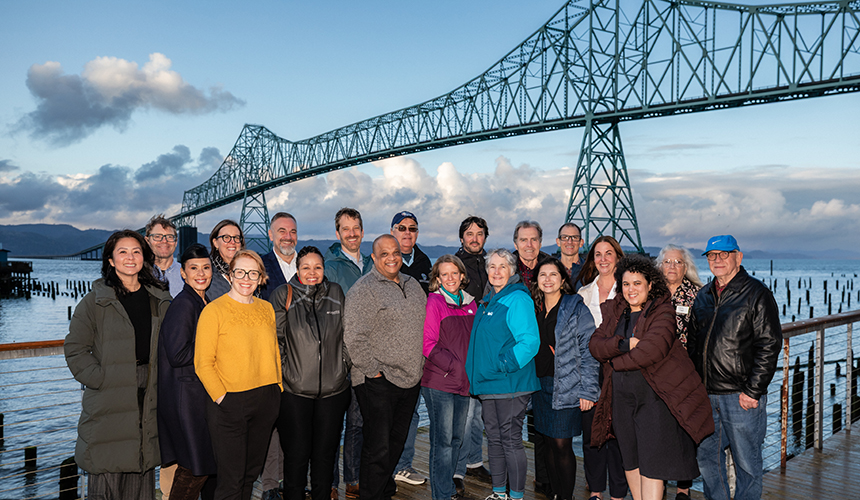
In April, Energy Trust of Oregon’s board of directors held their annual regional board meeting in Clatsop County. The board makes a point to visit different parts of the state each year to stay grounded in the communities they serve and to experience firsthand how Energy Trust’s work with homeowners and business leaders is creating energy solutions. As part of their two-day visit, the board connected directly with the community, including visiting various Energy Trust project sites and speaking with local business owners, employees, elected officials and community members.
The board visited Fort George Brewing’s production facility in Astoria, to see how Energy Trust has supported efficiency upgrades across the brewery’s growing campus. From boiler improvements to Strategic Energy Management (SEM), these efforts are helping reduce energy use and operating costs as the company continues to expand. With $15,000 in incentives from Energy Trust, the upgrades are expected to save about 40,000 kWh of electricity and 10,000 therms of natural gas each year, helping the brewery run more efficiently while supporting its continued growth.
Energy Trust’s impact on housing was also on display at the Owens II Affordable Housing Community in downtown Astoria, where the board learned how Energy Trust is helping bring energy-efficiency to the community’s newest affordable housing. With rooftop solar and high-performance building features, the project is designed to lower energy costs, improve resilience and support long-term housing stability for residents in the region. Projected energy savings are 110,000 kWh per year.
That focus on long-term community investment continued at the Columbia River Maritime Museum, where they got a look at the new Mariners Hall expansion and how Energy Trust is supporting its design from the ground up. With high-efficiency systems and smart design features, the project is set to cut energy use while creating a more modern, interactive space. Energy savings are expected to be roughly 25,000 kWh annually.
The board also stopped by the Astoria Aquatic Center, where energy-efficient upgrades and SEM are helping the facility run smarter day to day. From pool covers to improved building controls, the changes are reducing energy use and lowering costs while keeping the space comfortable for the community.
Within the newly renovated Astoria Public Library, the board saw how Energy Trust’s early design assistance and incentives helped integrate efficiency into a historic upgrade. Thoughtful improvements like upgraded lighting and cooling systems are reducing energy use while supporting a more open, modern space for the community.
Throughout each visit, there was a clear, intentional display of how each organization shows up for the people they serve.
“It was striking, but not surprising, to hear on each of our tours how every location is focused on customer satisfaction — satisfaction with their product, comfort or ability to access their services,” said Michael Colgrove, executive director of Energy Trust of Oregon. “For them, it’s about the right water temperature, the quality of a product when it’s shipped across the globe or making sure someone finds a place to call home,”
Alongside the site tours, the regional board meeting also brought in local voices to ground the conversation in the broader community. The board heard an economic development update from Matt McGrath, deputy director of the Port of Astoria, as well as a presentation from Jenny Pool, executive director of Consejo Hispano, who shared insights on community needs and engagement in the region.
Together, the tours and presentations offered a clear, firsthand look at how Energy Trust’s work is showing up across industries, businesses and homes throughout the region—and where it can continue to make an impact moving forward.