
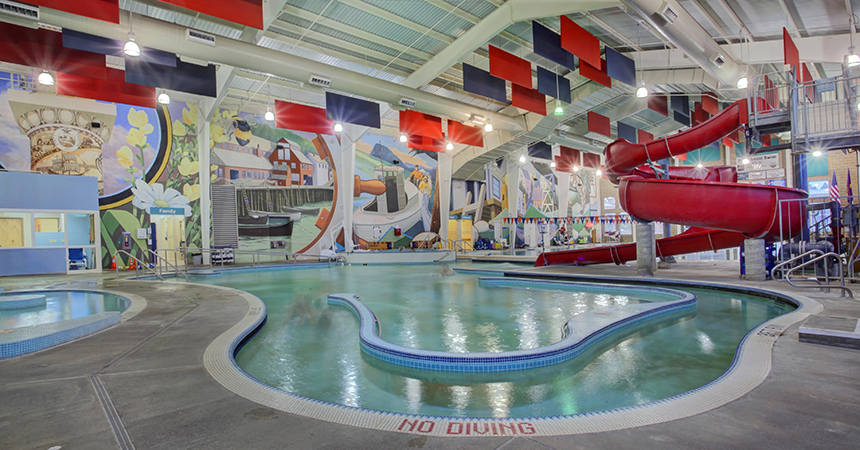
The Astoria Aquatic Center has been a cornerstone for recreation and community in Astoria for nearly 30 years. Since opening in 1998, the center’s four pools and gym have hosted everything from swimming lessons and water aerobics to open swim and private events.
Keeping a facility like this running smoothly requires constant attention. As director of Astoria Parks and Recreation, Jonah Dart-McLean oversees daily operations and long-term maintenance. With the building nearing three decades old, that work comes with its share of challenges.
“Some of the biggest issues we face are the unexpected ones,” Dart-McLean explained. “There are components you can’t see that can fail without warning, and when that happens, it can lead to some big challenges.”
To help address these challenges, Astoria Parks and Recreation partnered with Energy Trust of Oregon and their utility partners, NW Natural and Pacific Power, on building and equipment upgrades to help improve performance and reduce energy use.
One of the most impactful improvements came in 2021 with the installation of a custom pool cover. By reducing heat loss when the pools are not in use, the upgrade lowered energy demand, earning a $17,700 cash incentive and resulting in $19,900 in estimated annual energy cost savings.
“It just made sense to upgrade,” Dart-McLean said. “The incentive was significant, and the pool covers have had a big impact on our energy savings.”
The facility continued building on that progress in 2024 with a custom HVAC building controls upgrade. This system allows staff to better monitor and adjust heating, ventilation and humidity levels throughout the building. The project earned a $57,700 incentive and resulted in $33,300 in estimated annual cost savings.
In 2025, the department expanded its energy-saving efforts by enrolling in Energy Trust’s Strategic Energy Management (SEM) offering. The offering focuses on improving day-to-day operations and helping organizations uncover low- and no-cost opportunities to save energy. Facilities Maintenance Coordinator Charlie Shumar leads the initiative as the aquatic center’s Energy Champion.
With help from an Energy Trust energy coach, Shumar identified equipment that did not need to operate at full capacity around the clock. Variable speed pumps, for example, were reprogrammed to reduce output during closed hours. These adjustments have helped cut energy use without affecting operations.
The team also addressed a less obvious but costly issue. “We found a crack in the pool,” Shumar said. “We’re already paying a lot to keep that water hot, so losing it was a big deal.”
Because replacement water must be heated to match the pool’s temperature, even small losses can drive up energy use. Repairing the leak reduced both water and energy waste.
Through participation in the SEM offering, the aquatic center has received $7,900 in incentives so far and is saving about $19,900 in energy costs annually due to energy-saving actions and milestones.
For Shumar, the biggest takeaway is how approachable the process has been.
“I would really encourage others to participate,” he said. “Some of the fixes and things we’ve done have been so simple. None of it has been complicated or time-consuming, and it’s great to have another set of eyes looking at your systems.”
In total, Astoria Parks and Recreation has received more than $83,300 in cash incentives and is saving an estimated $73,100 in energy costs each year. By investing in both equipment upgrades and smarter day-to-day operations, the aquatic center is set up to serve the community more efficiently for years to come.
Want to learn how Energy Trust’s SEM offering can help your facility save on energy costs? Contact us for details.