
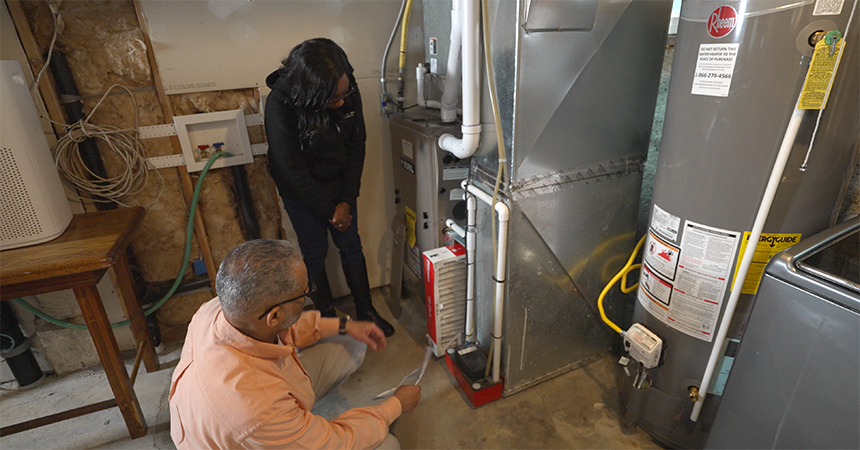
A first-of-its-kind training center is preparing more people for high-demand careers in energy efficiency—careers that help Oregon businesses and families use less energy and lower costs. Launched by nonprofit EnerCity Collaborative (ECC), the center provides hands-on training and mentorship for BIPOC contractors, particularly Black students and trainees, as demand for skilled workers continues to grow.
“I wanted to create a place where there were other folks who looked like me that could come and get this training, to be able to do this work in the industry,” said ECC founder James Metoyer.
With support from Energy Trust of Oregon, ECC leads Building Performance Institute (BPI) certification courses. Graduates then go on to work directly with people, families and businesses to identify ways to save energy in their homes and buildings. Through that work, they help install energy saving tools like insulation, heat pumps and efficient water heaters.
The training curriculum—developed in partnership with Oregon-based Tahn Analytics—was designed to support different learning styles, blending audio, video and hands-on instruction. The training takes place inside a home in North Portland, so students can immediately see how the work shows up in real life. Following a lecture or training module, students then move on to diagnosing air leaks, testing equipment and understanding how homes perform day to day.
“We designed something that meets people where they are, supports different learning styles and builds real confidence.” said Mujidat Saaka, founder of Tahn Analytics. “The goal is bigger than passing a test. It was creating a pathway people can carry back into their communities and turn into long-term opportunity.”
With this curriculum, more than 90% of students successfully earn their credentials.
“It really opened my eyes,” said Janelle Waltz, an ECC trainee. “There’s a lot of people, especially in the underrepresented community here in Portland, who may not know that resources are out there regarding energy efficiency. The long-term benefit for my community of having this training is being a resource.”
Trainees go on to work with a variety of organizations including community-based organizations like Community Energy Project which make homes repairs for Portland families with lower incomes.
“EnerCity Collaborative gave me access to an education that shaped my foundation in building science,” said Abasi Umoh, now an in-home energy auditor at the Community Energy Project, “I’m able to work with families, figure out how we’re going to be able to fund a new high-efficiency heat pump, get their energy bills down, and make sure that their equipment is working.”
Communities of color pay higher shares of their income on energy bills and are also significantly underrepresented in the energy workforce. ECC’s work addresses both.
“When those most impacted by energy burden and housing inequalities are invited to the table and can be a part of the solution, those solutions are created to help them,” said Metoyer. “At EnerCity Collaborative, we’re aiming to build community power so they can live healthier, safer and more energy efficient lives in their own homes.”
Energy Trust sponsors seats in ECC’s BPI training cohorts and provides financial support and resources to ECC for strategic planning as it grows its training programs. Visit Communities to learn more about how Energy Trust supports nonprofits, cities, towns and others to help communities achieve clean energy goals.