
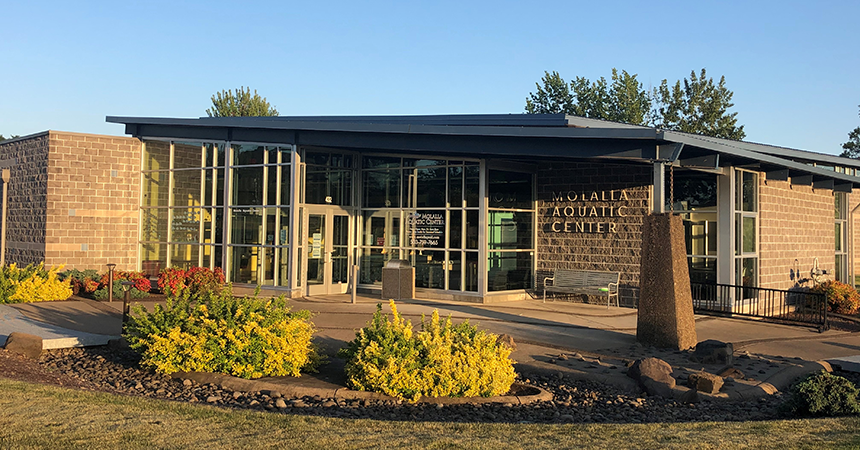
As the only facility of its kind in the area, the Molalla Aquatic Center is always buzzing with activity, from fitness classes to high school swim meets. But in 2013, the community nearly lost this amenity for good due to a funding shortage. However, thanks to a grassroots campaign, the pool reopened in 2018 with support from a publicly funded bond. Now, the Molalla Aquatic Center staff has a new challenge: keeping up with maintenance.
Over the years, the center has replaced aging equipment with modern energy-efficient models to cut back on utility costs and become more sustainable. “We’re trying to make the center as energy efficient as we can,” said Julie Harris, the Molalla Aquatic Center’s administrative coordinator and interim superintendent. Starting with lighting, the center has replaced almost all original equipment out of necessity or to improve operations. “Anything to try to save,” said Harris.
The center had previously worked with Energy Trust of Oregon on a pool cover replacement, so Harris’ predecessor reached out to explore additional incentive opportunities. After a site walkthrough with an Energy Trust contractor, Elevate Building Commissioning conducted a Technical Analysis Study and determined a retrocommissioning project could help optimize the center’s HVAC and water heating systems to reduce energy use.
With the right adjustments, equipment can run like new again
Retrocommissioning is a way businesses and organizations can improve energy efficiency without needing to replace existing equipment. This option is ideal for equipment that isn’t at the end of its useful life and could benefit from a tune-up to improve performance.
In the Molalla Aquatic Center’s case, while the HVAC and water heating system serving the pool area, which is in an indoor space, was working seemingly fine, its controls settings weren’t optimized. The center installed the system in 2022, so Harris was surprised to learn its controls settings weren’t optimized. “I was shocked because the equipment was basically brand new,” she said. “I just thought it was running as efficiently as it possibly could.”
Through a handful of controls adjustments, such as reducing supply fan airflow during unoccupied times, the center’s HVAC and water heating system will save a surprising amount of energy. The improved efficiency will save the center up to $13,000 a year in utility costs. “We’ve already noticed a drop in our energy bills,” said Harris.
The equipment tune-up reduced energy use while improving comfort and safety
Lower energy use and associated costs weren’t the only welcome results of this retrocommissioning project; Harris was surprised at how much more comfortable the space is now. “The adjustments made it so that it doesn’t get as miserably humid on the pool deck,” she said. Harris noted the change is most appreciated when there are big events at the center. “It stays cool even when there are 200 people here to watch a swim meet.”
The project also led to a noticeable safety improvement. The controls adjustments helped reduce the amount of noise the HVAC makes when operating, which is useful in the event of an emergency. “This is a safety improvement because our lifeguards can hear each other and what’s going on in the pool better,” she said.
Saving energy is easier with a trusted partner
For Harris and her team, working with an Energy Trust contractor made all the difference for this project. “It was an amazing experience working with [Elevate Building Commissioning],” she said. “They were helpful, answered all my questions and made sure I was keeping track of everything we needed to get the incentive.”
This unexpected energy-saving opportunity has Harris wondering what other ways the center could become more efficient. While she hasn’t decided on a project yet, Harris knows where she’ll turn to for help. “Always reach out to Energy Trust if you have a project in mind, and even if you don’t, see what they can offer you,” she said. “This HVAC project wasn’t on our radar, but it benefited our pool greatly.”
Learn more about custom and retrocommissioning incentives for commercial properties by visiting our website.
Photos courtesy of Molalla Aquatic Center