
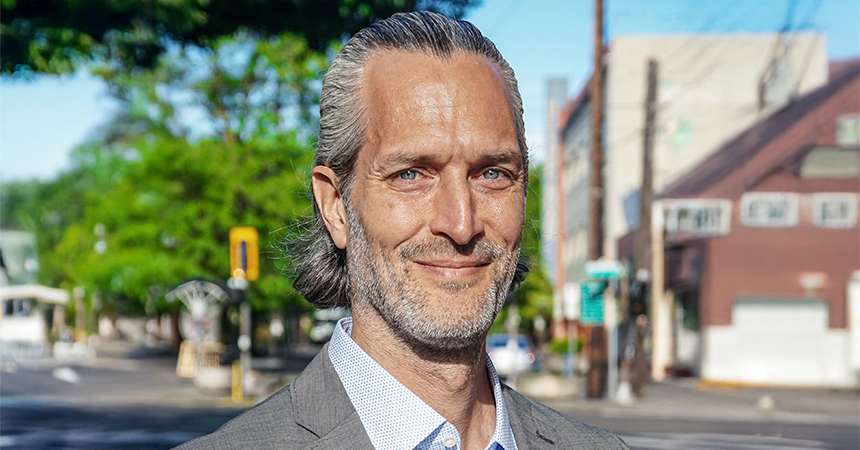
This is a part of a series of blog posts amplifying community voices. These views reflect the perspective of the Changemaker and do not necessarily represent those of Energy Trust of Oregon.
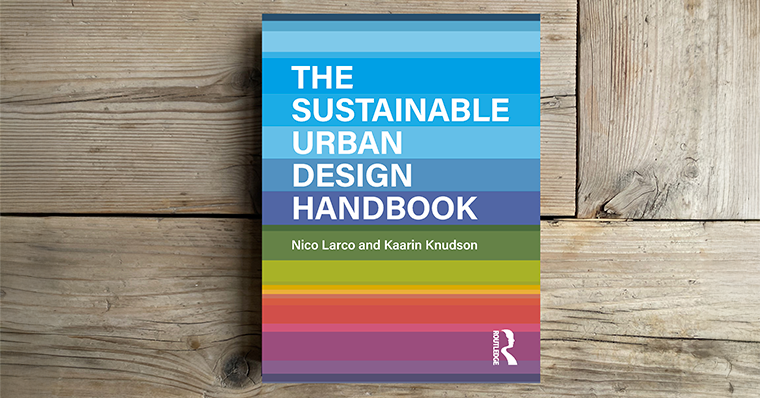
Nico Larco, AIA, is an urban designer, architect, professor at the University of Oregon and director at the Urbanism Next Center. Larco’s interest in how cities are shaped began with a study abroad program in Rome, where he saw how urban density could coexist with comfort, convenience and open spaces. This led to a career in urban design, and eventually a deeper focus on sustainability and how emerging technologies are reshaping cities. Larco has practiced at architecture firms including William Rawn Associates, where he designed award-winning residence halls at Amherst College. His passion for creating livable, adaptable cities stems from witnessing rapid urban transformation and believing thoughtful design can help communities thrive through technological change. He is lead author of the Sustainable Urban Design Handbook (2024) and helps cities worldwide future-proof their development. His research has been featured in The New York Times, Wired and Bloomberg.
What drew you to architecture initially, and when did you first realize the importance of the urban scale in creating sustainable communities?
When I was in high school, I was interested in both art and math – and loved trying to understand the human experience. Architecture seemed like a great way to merge all of these things together. It also seemed like a way to improve our lives. I did a study abroad in Rome in college and completely fell in love with cities.
In graduate school, I became interested in how urban design and planning impact the environment and our quality of life. Cities like Vancouver, Stockholm, Copenhagen and New York, made me realize there are ways of organizing cities that can work well. You can have a fantastic quality of life and live in a tremendously more sustainable way than with urban sprawl.
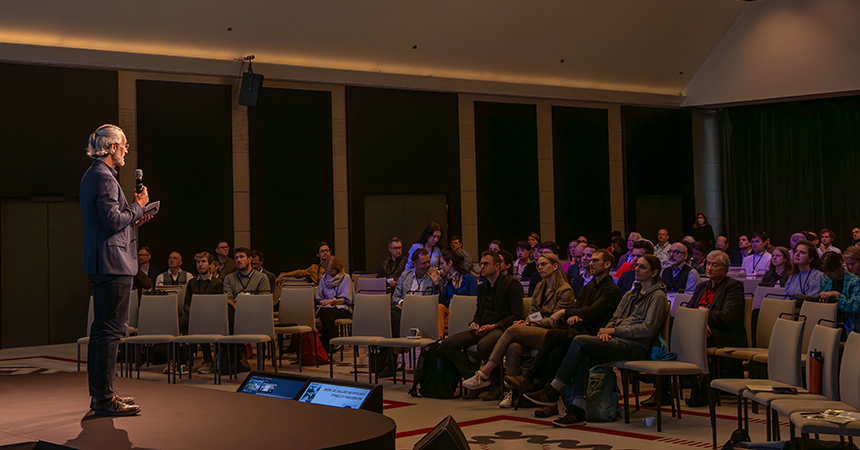
Larco is the Director of the Urbanism Next Center and has led the annual Urbanism Next Conference in the US and in Europe.
Your Sustainable Urban Design Framework is a comprehensive approach to rethinking how we build cities. What were you trying to capture that wasn’t already being addressed?The biggest goal was to get our arms around the topic, because there is a lot of fantastic work in the field, but much of it is siloed. We wanted to make it easier to know what to do at different scales for energy use, water, ecology and habitat, equity and health – and know how each area affects the other. And it’s open-ended. You can use it to evaluate how easy or difficult different sustainability features will be to achieve for a given project.
Policymakers and community stakeholders with goals like walkability or ecological rigor need to know how to get them done in the real world. The Framework empowers people to advocate for what they want and call out false claims. My hope is to demystify these things, and give designers, planners, developers and community stakeholders the agency needed, to build trust and buy-in, and make sustainable urban design the norm.
So, the Sustainable Urban Design Framework isn’t necessarily prescriptive, but it’s a tool to find the right solutions?
If you asked me to design my dream city, it would be high-density, mixed use and multimodal. But that’s not always possible with market realities, and cultural and political priorities. The goal is to show people the topics they should be considering, some of which are easier than others to achieve, and inspire them to do the most sustainable project possible. If you’re doing a single-family development, you can still try to get the best sustainability outcome possible. We invent our built environments — we make them. Let’s make better ones.
You’ve noted that “the best way to stop sprawl is to make cities worth staying in.” What examples of this have you seen?
Hands down, density makes everything more sustainable. But we don’t have to be as dense as Hong Kong, with giant skyscrapers filled with people. In the Netherlands, the density is wonderfully pleasant and completely livable. It lets so many things happen: biking, transit and natural systems, while avoiding feelings of overcrowding. You can walk to a café because there is enough density to support it.
Urban streets that are active and vibrant can be comfortable, and there can be great outdoor spaces as well. Not just places to drive through in your car, but places to be. Ground-level commercial spaces, semipublic outdoor areas with benches and green space. San Francisco, The Hague and Portland are examples of this. Good things happen when people encounter each other and are not overwhelmed by cars.
As for dense urban housing types, townhouses are a fantastic in-between that provide private outdoor space in a smaller footprint. More duplexes, triplexes and courtyard developments are also great ways to increase density in ways that I think many people in the U.S. would be happy with.
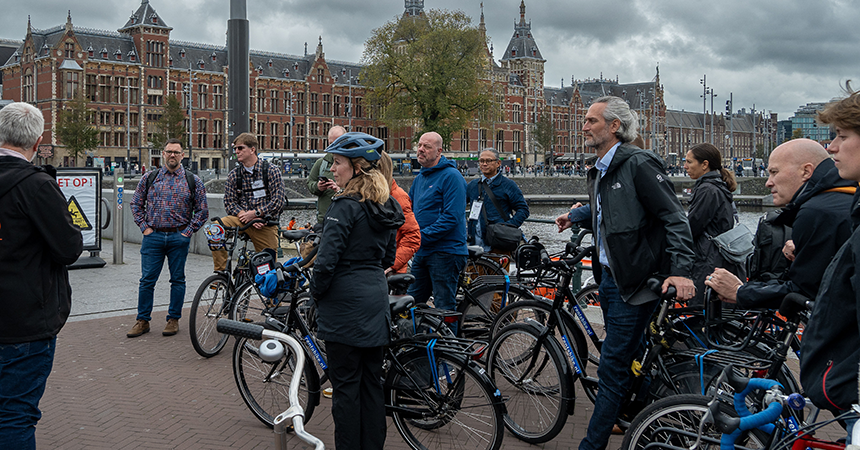
Larco has lived in the Netherlands and has worked on multiple projects there and across Europe over the last decade.
Are you hopeful for the future of urban density in the U.S.?
I am. When I was a kid, suburbs were the way everything seemed to be going. Then in the 1990s cities became ‘cool’, and not just as a place to go to work. COVID felt like a setback, but ultimately people like to be near each other. People are going back to the office, and post-COVID, it seems we are even more aware of how important it is to see people in person. It makes us happy.
We’ve gotten pretty good at designing energy-efficient buildings, but you focus on the spaces between buildings—the public realm, the street network, the overall urban form. Is this harder to get right? What makes a sustainable neighborhood different from a collection of sustainable buildings?
It is harder to get it right because it takes a lot of discipline and a lot of people aligning decisions to make sustainable places. For transit to work you need good public space, walkability, density and a mixture of live/work uses. That takes a lot of coordination, but when it works, the benefits are tremendous.
We live in a place where cars are easier because of the environment we’ve created. But we can create different environments where walking, biking and public transit are the obvious choices – and so are their benefits.
For young designers and planners who want to work on sustainable urban design, what advice would you offer? What skills or perspectives should they be developing?
I would want them to understand the system approach to their work. To understand urban design, you need to be familiar with planning at the city level, as well as landscape design and development. It’s not just one client you’re interacting with but a collaborative effort with a longer timeframe, and the moves you make are more durable; for instance, it’s not hard to move a wall, but it is tremendously difficult to move a street.
Strangely, one of the most useful classes I took in grad school was a real estate class. I’ve applied those learnings to a lot of work. It helped me understand developers and got me outside of my comfort zone. If you’re trying to understand the built environment, transportation, stormwater or ecology, you need to think broadly and be knowledgeable in a range of topics. You have to be able to understand and speak to different disciplines – that is critical.